
Private School Marketing: An Admissions-Season Playbook from First Ad to Open House



By Angelica · Updated November 1, 2026
Private school marketing in Indonesia for the 2027/2028 school year is already underway, well before most parents start searching. The seven school pages that gave a date opened their first admissions wave between August and November 2026, while searches for "penerimaan murid baru" (new student admissions) peaked in June in the last cycle.
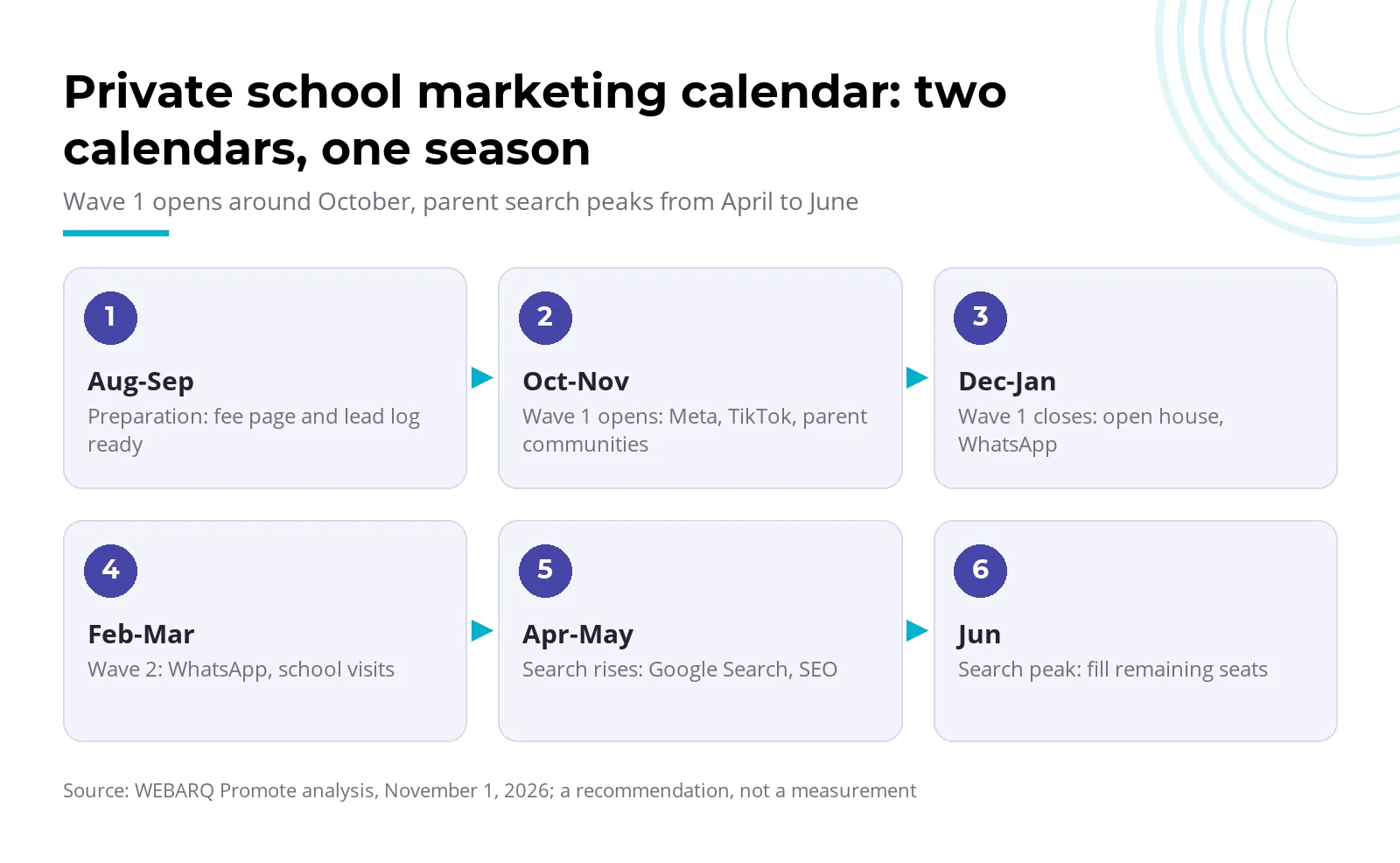
So you have two jobs on two calendars. October to March reaches parents who aren't searching yet. April to June catches the ones who are.
Key takeaways
- 55% of searches for "penerimaan murid baru" from October 2025 to September 2026 fell between April and June, yet the median wave 1 start in our small sample was October.
- Give each channel one job: Meta and TikTok start conversations, Search catches intent, WhatsApp qualifies, open houses convert.
- Set targets backward from empty seats using your own last two intakes. We found no usable school benchmark.
- Before raising ad spend, show your fees, label the WhatsApp number and maintain the Google profile.
When does the admissions season really start?
For private schools, the admissions season starts around October, about nine months before the new school year in July, while parent search only climbs in April and peaks in June. Admissions marketing has to be planned across the gap between those two curves.
WEBARQ Promote analysis: search demand
Method. On November 1, 2026, we pulled monthly Google Ads volumes through DataForSEO (location Indonesia, language Indonesian) for 30 admissions terms, covering October 2025 to September 2026.
Only 9 of the 30 terms had data. The other 21, including "biaya sekolah" (school fees) and "open house sekolah", returned no volume. That means below the tool's threshold or not tracked, not zero searches. So this data can't show what parents search when comparing fees.
| Term | Oct 2025 | Jan 2026 | Apr 2026 | Jun 2026 | Aug 2026 | Peak |
|---|---|---|---|---|---|---|
| penerimaan murid baru | 140 | 480 | 720 | 1,300 | 110 | June |
| jadwal spmb | 70 | 1,600 | 590 | 6,600 | 30 | June |
| tk swasta | 320 | 260 | 320 | 390 | 210 | June and July |
| playgroup | 3,600 | 3,600 | 4,400 | 4,400 | 3,600 | July (5,400) |
June searches for "penerimaan murid baru" ran about nine times the October 2025 level. January rises slightly; we haven't tested why.
"Jadwal spmb" (SPMB schedule) mostly reflects public-school demand. SPMB, which replaced PPDB, is the admissions system in force since February 28, 2025, under Permendikdasmen No. 3 of 2025; private schools take part through cooperation with regional governments or student referrals. So don't count that 6,600 as your market.
"Playgroup" stays fairly flat all year, between 2,400 and 5,400, so early-childhood schools have search demand outside the season.
WEBARQ Promote analysis: wave dates
Method. On the same day we searched private school admissions and read 13 school and news pages on admissions. Only 7 gave a start date for wave 1 of the 2027/2028 intake: one in August, five in October, one in November. The median is October 2026.
This sample is small and doesn't represent Indonesian private schools. The pages came from search rankings, and they skew toward Islamic and Catholic schools and toward Java. The wave dates also belong to the 2027/2028 cycle, while the search curve belongs to the cycle before. We assume the pattern repeats, which is untested.
Three patterns stand out:
- As of November 1, 2026, six of the seven schools had already opened wave 1, and one opened that day.
- Four of the seven pages offered a discount that shrinks by wave, such as an entry fee cut of 50%, then 30%, then 10%.
- Wave 1 ran two to five months, and two schools opened an earlier window in August.
That price ladder is the real sales mechanism: it gives parents a reason to decide before April. The table below is our recommendation, not a measurement.
| Month | Phase | Main channels | Goal | What to measure |
|---|---|---|---|---|
| Aug-Sep | Preparation | Website, SEO, Google profile, WhatsApp | Fee page and lead log ready | Pages live, lead log running |
| Oct-Nov | Wave 1 opens | Meta, TikTok, parent communities | First conversations | Leads by source, cost per lead |
| Dec-Jan | Wave 1 closes | Open house, WhatsApp, remarketing | Visits | Lead-to-visit rate |
| Feb-Mar | Wave 2 | WhatsApp, school visits | Applicants | Visit-to-applicant rate |
| Apr-May | Search rises | Google Search, SEO | Catch intent | Cost per visit |
| Jun | Search peak | Search by level and area, WhatsApp | Fill remaining seats | Seats left, cost per enrollment |
What is each channel's job in private school marketing?
In private school marketing, each channel should hold one job so you can judge it fairly: Meta and TikTok start the conversation, Google Search catches intent, WhatsApp qualifies, and the open house closes. Judge Meta on cost per applicant in October and it will look like a failure.
DataReportal put Indonesia's internet users at 230 million in October 2025. Ad-reach estimates for late 2025 were YouTube 151 million, Facebook 121 million, Instagram 108 million and TikTok 180 million aged 18 and over. Those aren't unique people or parents, so treat them as upper limits.
Google Search and SEO
Search serves parents already looking, peaking from April to June. Prioritize your school's name, then "school [level] in [area]". A general term such as "tk swasta" (private kindergarten) has an estimated CPC of US$0.24 with low competition (Google Ads data via DataForSEO), but only hundreds of searches a month nationwide.
SEO has to start before April because it takes time. Our Global Sevilla School case study reports 203% growth in organic traffic and 78% for reaching Google's first page in 6 months. It publishes no enrollment data, so read it as an SEO result only.
As of November 1, 2026, Google shows an AI Overview for "promosi sekolah" (school promotion), so watch how that affects your traffic.
Meta and TikTok for parents
Target parents, not students. On TikTok, Indonesia is a restricted location: if an audience includes under-18s, the Lead Generation objective isn't available, detailed targeting doesn't apply to that group, and ads aren't delivered to users under 14 (accessed November 1, 2026).
Since 2022, Google has turned off ad personalization for accounts older than the digital age of consent and younger than 18. That isn't an ad ban, but personalization won't find teens for you.
The Meta Advertising Standards, which we read on November 1, 2026, have no rule specific to school ads. The relevant part is the form: lead ads may not request sensitive categories such as government IDs, health or religion without Meta's written permission. Ask only for the parent's name, WhatsApp number, grade level and intake year. Have your paid social team check the form before launch.
Send ad clicks to a lead generation landing page for each level, not the homepage.
WhatsApp as the first classroom
WhatsApp is where parents first experience the school's service, so treat replies as part of the product. The WhatsApp Business Platform opens a 24-hour customer service window when a user sends a message. Inside it you can reply freely. After it, you can send only approved templates to users who opted in.
A Saturday night question answered on Monday morning has already left the window. Write down a reply standard, including weekend cover while a wave is running. We have no sourced response-time figure, so measure your own.
A first script needs three questions: grade level, intake year and home area. Then offer a visit. Log every chat with date, source, level and status.
Open houses and school visits
The open house is the main conversion point, because that's where interest becomes a family decision. In our sample, a Jakarta international school says it holds open houses three times a year with early-bird offers for attendees, and a BSD City school gave attending families an admission-fee discount.
Schedule one open house before each wave closes, so the discount deadline becomes a reason to come. Send a WhatsApp reminder, record attendance and contact families the next day.
How do you build a funnel from inquiry to enrollment?
Build the enrollment funnel backward from empty seats per level through four stages (lead, visit, applicant, enrollment), using the ratios from your school's last two intakes. We don't use outside benchmarks, because we found no sourced conversion rates for Indonesian schools.
| Stage | Definition | How to set the target | Owner |
|---|---|---|---|
| Lead | Parent makes contact by form, WhatsApp, phone or DM | Visit target divided by lead-to-visit rate | Marketing |
| Visit | Attends an open house, tour or trial class | Applicant target divided by visit-to-applicant rate | Admissions |
| Applicant | Completes the form and pays the registration fee | Enrollment target divided by applicant-to-enrollment rate | Admissions |
| Enrollment | Pays the entry fee and the seat is locked | Empty seats per level | Head of admissions and finance |
Pull old data from guest books, chats and forms, split by source and wave. If none exists, start logging today.
Hypothetical example, not a benchmark. A school has 120 empty seats. Suppose its last two intakes show applicant-to-enrollment at 80%, visit-to-applicant at 50% and lead-to-visit at 30%.
Then 120 ÷ 0.8 = 150 applicants, 150 ÷ 0.5 = 300 visits, and 300 ÷ 0.3 = 1,000 leads. These ratios are invented to show the math, so replace them with yours.
Report the four stages to the foundation on one page with a Looker Studio board dashboard.
What trust signals should a school fix before parents get in touch?
Before parents get in touch, make five signals easy to find: current accreditation, fee details, teacher profiles, maintained Google reviews and an alumni record. That list is our recommendation, not a finding, because we found no survey of Indonesian parents on this.
| Signal | What should show | Where |
|---|---|---|
| Accreditation | Current status and year | Homepage, admissions page |
| Fees | Breakdown by level, installment options, discounts by wave | Fee page |
| Teachers | Names, qualifications, experience | Team page |
| Reviews | Maintained Google Business Profile, replies to reviews | |
| Alumni | Verifiable record of further study | Results page |
On fees, one sample school puts a fee table and installment option on its registration page. At minimum, show a range, so families who contact you have already passed the fee filter.
How much should a school spend, and when should it stop a campaign?
Set the budget from the cost per enrollment the school can carry, then split it by phase according to where enrollments came from in the last two intakes. Stop a campaign when a level is full, cost per visit passes your limit or chats go unanswered. We give no standard percentages because none are sourced.
The formula: the cost per enrollment you can carry × the enrollment target = the budget. Continuing the hypothetical example, an illustrative limit of Rp 1,250,000 for 120 seats gives a budget of Rp 150 million, or Rp 150,000 per lead. If most of last year's enrollments came from wave 1, weight the budget early. For Search, the curve above is a starting point, since 55% of searches for "penerimaan murid baru" fall between April and June. A school that's full by March doesn't need that share.
Cut a campaign in these cases; tune the thresholds to your data:
- A level is full or has a waiting list. Turn off its ads the same day.
- Cost per visit stays over the limit for two straight weeks after you've checked the message and the page.
- The chat queue passes your reply standard. New leads will only add disappointed parents.
- One source produces many leads and no visits.
A school with few seats and an internal waiting list should skip ads and maintain its Google profile.
What does Indonesia's data law say about children's data?
Article 25 of Law No. 27 of 2022, the Personal Data Protection Law (UU PDP), says a child's data must be processed in a special way and requires consent from a parent and/or guardian. Children's data also counts as specific personal data, alongside health and biometric data.
Schools can act on three things now:
- Forms. At the lead stage, ask only for the parent's contact. Collect the child's name, birth date and documents at application, with consent from the parent that you can prove, not just a ticked box.
- WhatsApp. Don't ask for birth certificates or family cards through staff's personal chats. Provide a limited-access upload on the form.
- Retention. UU PDP gives people the right to access, correct and delete their data, and requires processing to end once the purpose is met. Decide when data from families who didn't apply gets deleted.
Article 25 doesn't spell out the age limit or the form of consent. The implementing rule isn't in force yet, but it lands mid-season.
Per Katadata's report, Government Regulation (PP) No. 33 of 2026 was signed July 16, 2026 and takes effect January 16, 2027. The report says data controllers must verify that consent really comes from a parent or guardian, and a consent button alone won't do. We haven't found the official text, so set up your consent flow with the foundation's legal counsel before January. This section is general information, not legal advice.
Which mistakes burn a school's budget?
Four mistakes burn a school's budget: starting in April, misreading "jadwal spmb", reporting lead counts and running ads with nobody staffing WhatsApp. They follow from the numbers and rules above, though we have no data on how often they happen.
- Starting in April. The school pays for peak demand after its wave 1 discount has ended.
- Reading "jadwal spmb" as your market. That 6,600 points mainly to public schools, so the keyword risks irrelevant clicks.
- Reporting lead counts. A lead who never visits doesn't fill a seat.
- Live ads, empty WhatsApp. You're paying for conversations nobody answers.
What's the first step this week?
Start with three jobs that use no media budget. Count empty seats per level, gather your last two intakes by source, and make sure the WhatsApp number on your website is clearly labeled and staffed.
If wave 1 isn't open by November, don't chase it with a big budget. Set a deadline and one open house date first.
Frequently asked questions
What are the steps in a private school marketing strategy?
Start with empty seats per level, then work backward to the leads you need using your last two intakes. Fix the fee page, WhatsApp and Google profile next. Open wave 1 around October, give each channel one job, and have Search ready for April to June.
When should a private school start its admissions marketing?
Around August for preparation and October for wave 1. In our small sample, seven schools opened wave 1 between August 2 and November 1, 2026, with a median of October. Parent search peaks from April to June, so a school that waits for Search misses its own first wave.
Can a school advertise to under-18s?
Only with limits. TikTok lists Indonesia among the locations with restrictions on audiences under 18, and it doesn't deliver ads to users under 14 there. Google turns off ad personalization for teen accounts above the digital age of consent. The cleanest option is to target parents.
How should a school handle children's data from registration forms?
Article 25 of Indonesia's Personal Data Protection Law requires consent from a parent and/or guardian to process a child's data. Collect the parent's contact first and the child's data only at application, with consent you can prove. Limit access, set a retention period, and prepare consent verification before PP No. 33 of 2026 takes effect on January 16, 2027, according to press reports. This is general information, not legal advice.
Want your school to be found when parents start searching in April, not after? The WEBARQ Promote SEO team can map keywords by level and area and build the plan now.