

Landing Pages for Lead-Generation Ads: A Blueprint, a CRO Checklist and the Mistakes That Waste Budget



By Bagas · Updated October 31, 2026
Once the ad click is paid for, your landing page decides your cost per lead. At the same CPC, a page converting at 4% costs half as much per lead as one converting at 2%. That is arithmetic, not a promise.
For a landing page for lead generation, you control three things before budget goes out: section order, form fields, and readiness on speed, tracking and data consent. Fixing them before launch costs no media budget.
Key takeaways
- Cost per lead equals CPC divided by conversion rate. At CPC Rp 4,000, moving from 2% to 4% cuts it from Rp 200,000 to Rp 100,000 (illustration).
- The page's headline, offer and button should repeat the ad's promise, as Google Ads advises.
- Every form field needs a named use. Compare cost per qualified lead, not raw lead counts.
- Before launch, check Core Web Vitals, one conversion per lead, the GCLID in your CRM, and your UU PDP basis for processing data.
What is a landing page, and when should ads skip the homepage?
A landing page is a standalone page built for one campaign and one action, where visitors arrive from an ad or a link. A homepage serves many goals and invites people to explore, so skip it when an ad asks for one action, such as filling in a form.
The narrow exception: pure brand ads for people searching your company name.
For everything else, Google Ads guidance (as of October 2026) is blunt: pick a page that closely matches the ad and keywords, mirror the ad's call to action, and put key information near the top. Google's example: an ad offers a free tour, and the page shows a sign-up form prominently.
Landing page quality is one of three Quality Score components, but Google calls the score a diagnostic tool, not an auction input. Don't promise a lower CPC from a better page, since Google gives no size of effect.
What section order works for a B2B or BFSI lead page?
We suggest this order: hero, proof, how it works, form, objections, then legal, because visitors need a reason to trust you before they hand over personal data. This is a WEBARQ Promote framework built from Google Ads guidance, Nielsen Norman Group and UU PDP, not a measured result.
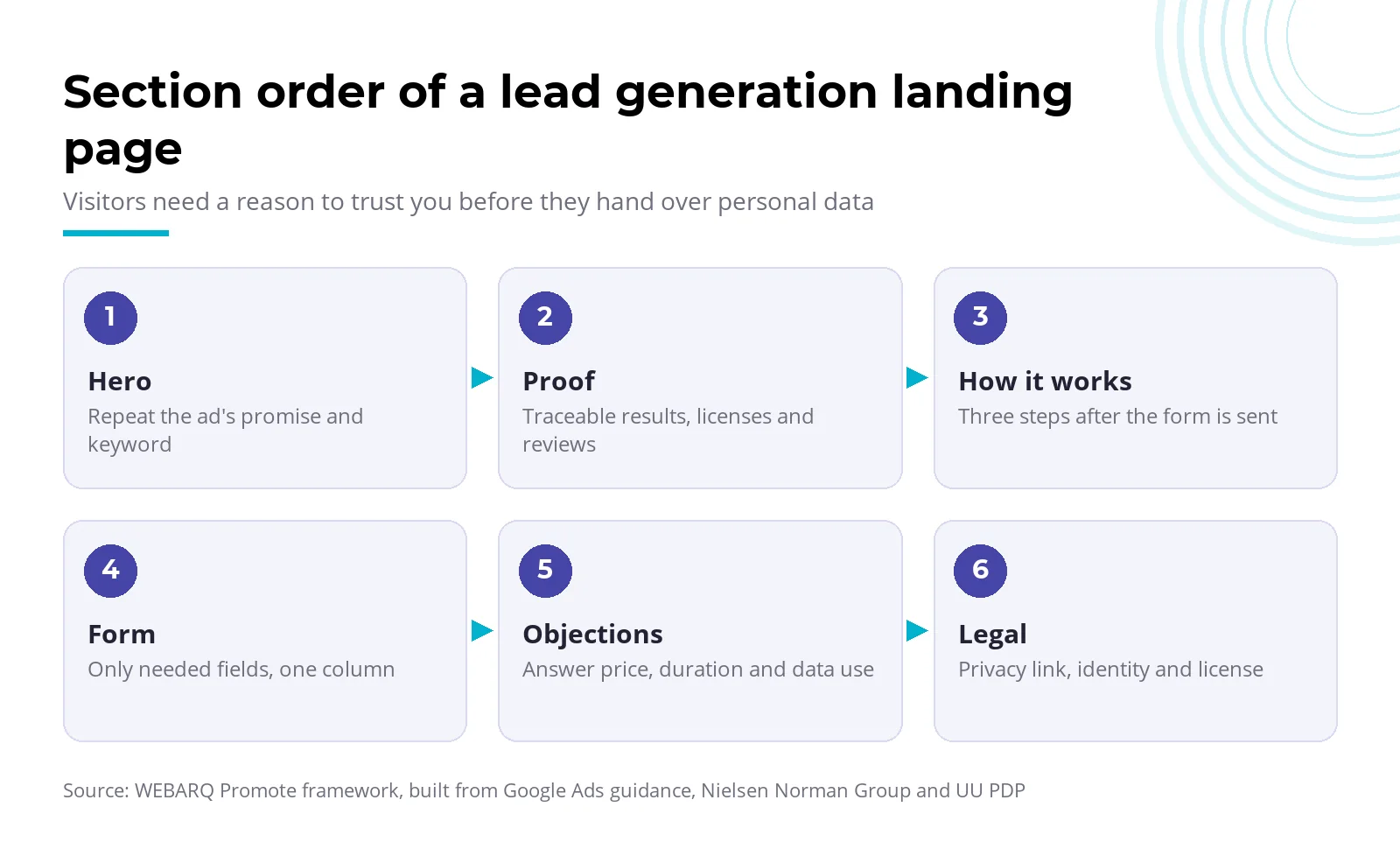
Hero: repeat the ad's promise
Confirm the visitor is in the right place. Repeat the ad's promise and keyword in the headline, use one primary button, and drop slogans, long menus and pop-ups.
Proof: only what can be traced
Use published client results, valid licenses or registrations, and genuine reviews. Unsourced numbers and bare "trusted" claims add doubt, especially in finance.
How it works: after submit
Write three steps. Say who gets in touch, by WhatsApp or phone, and how soon, if your team can keep it. BFSI (banking, financial services and insurance) pages should not promise loan approval or returns here.
Form: few fields, one column
Nielsen Norman Group advises a single-column layout, labels that stay visible (not placeholders) and at most one or two optional fields. A CHI 2014 study it cites found forms following usability guidelines were submitted error-free on the first try in 78% of cases, against 42% for those breaking them. That measures successful completion, not conversion lift.
Objections: answer before they ask
Three to five short questions: price range, duration, data use and who sees it. Don't hide fees.
Legal: short but complete
Add a privacy notice link, company identity, contact details and a license statement for BFSI. Drop other footer exit links.
How many form fields do you need: volume or lead quality?
The right number is what your follow-up actually uses, with no universal figure. Nielsen Norman Group says to remove fields whose data can be derived, collected later or left out, and cut one of its forms from six fields to two.
This table is a qualitative WEBARQ Promote framework, not a measurement. We found no primary study measuring both per field.
| Field | Volume | Lead quality | On mobile | UU PDP note | Keep when |
|---|---|---|---|---|---|
| Name | Flat | Weak signal | Light | Only what you need | Always, one field |
| Phone/WhatsApp | Tends to drop | Easier to reach | Light, numeric keypad | State contact purpose | Sales calls or chats |
| Moderate | Good for material, slow reply | Medium | State the purpose | Next step is email | |
| Company | Slight drop | Strong B2B filter | Medium | Stated purpose only | B2B, not consumer BFSI |
| Job title | Drops | Strong for account fit | Medium | Personal if tied to a person | Long-cycle B2B |
| Budget/loan amount | Larger drop | Strong, but self-reported | Medium | May touch personal financial data; get legal review | Use range buttons; BFSI asks at application stage |
| "How did you hear" | Slight drop | Attribution only | Medium | Unneeded with UTM and GCLID | Rarely |
The legal basis sits in Law No. 27 of 2022 (UU PDP). Articles 16(2) and 27 call for processing that is limited and specific. Personal financial data counts as specific personal data under Article 4(2)(f), and its elucidation names bank balances and credit card data, among others.
Article 34 requires an impact assessment for high-risk processing. Its examples include specific personal data and systematic scoring. A lead form won't always trigger it, but financial data plus lead scoring is worth raising with legal.
WhatsApp or a form?
Decide by who replies. If sales is active on chat, a WhatsApp button with a prefilled opening message works beside the form, not instead of it. But a tap isn't a conversation, so don't count it as a lead, and keep the ad source recorded.
How does page conversion rate move cost per lead?
Cost per lead (CPL) equals CPC divided by conversion rate (CR), so every rise in CR lowers CPL with no extra budget. This table is a hypothetical illustration, not a benchmark: budget Rp 50,000,000, CPC Rp 4,000, so 12,500 clicks, with 30% of leads qualifying.
| Page CR | Leads | CPL | Qualified leads | Cost per qualified lead |
|---|---|---|---|---|
| 2% | 250 | Rp 200,000 | 75 | Rp 666,667 |
| 4% | 500 | Rp 100,000 | 150 | Rp 333,333 |
| 6% | 750 | Rp 66,667 | 225 | Rp 222,222 |
Taking CR from 2% to 4% yields as many leads as doubling the media budget to Rp 100,000,000, provided CPC holds, which it may not at scale. So cost out conversion rate optimization (CRO) beside any budget increase.
There's a trap. Suppose a short form converts at 6% with 20% of leads qualifying, and a longer form at 4% with 30%. Both produce 150 qualified leads at Rp 333,333, though the short form looks 50% ahead on raw leads. This is also hypothetical; see our piece on lead quality in insurance and multifinance.
For reference, Unbounce reports a 6.6% median for Q4 2024, from 41,000 pages and 464 million visits. That is a global vendor-platform median. We found no Indonesian benchmark, so use your own history.
The Duitku campaign recorded around 200,000 clicks and about 17,000 conversions, and its A/B testing covered landing pages and banners. Those whole-campaign figures don't separate the page's contribution. Keep the two apart in your Looker Studio board dashboard.
What should you check before the ads go live?
Check five areas before budget runs: message match, speed, mobile, tracking and personal data. A page is ready when lab speed tests hit target, one test lead produces one conversion per platform, the GCLID reaches the CRM and legal has settled the data basis. One tracking failure is enough to make the whole CPL report misleading.
Platform details in this table follow Google, Meta and web.dev documentation as of October 2026.
| Area | What to check |
|---|---|
| Message | Headline, offer and button repeat the ad's promise and keyword |
| Speed | LCP (Largest Contentful Paint) within 2.5 seconds, INP (Interaction to Next Paint) of 200 milliseconds or less, CLS (Cumulative Layout Shift) of 0.1 or less at the 75th percentile on mobile |
| Mobile | Easy-tap buttons, one-handed form, key information near the top |
| GA4 | Form success fires one key event, such as generate_lead |
| Google Ads | Auto-tagging on, enhanced conversions for leads (Google Ads documentation) set up, tag checked with test submissions, GCLID stored with the lead |
| Meta | With Pixel and Conversions API, send the same event_id and event_name (Meta documentation) so the event counts once |
| End-to-end test | One test lead reaches the CRM with UTM and GCLID; one conversion shows per platform |
| Personal data | Basis agreed with legal, purpose and privacy link visible, withdrawal route available |
| BFSI | Consent to offers over personal channels is not a condition of applying |
One speed trap: per web.dev, lab tools such as Lighthouse can't measure INP because there's no user input. A new page with no traffic hasn't yet proved a pass, so recheck field data once ads are running.
Consent under UU PDP
Consent is one of six processing bases in Article 20(2), and which fits your form is a legal judgment. If you rely on it, Article 21 requires you to explain, among other things, purpose, data types and retention period. Where the consent also covers other purposes, Article 22(4) says the request must be clearly distinguishable from other matters. Article 22(5) makes consent that fails paragraphs (1) and (4) void by law. Article 24 requires proof, while Article 40 requires processing to stop within 3 x 24 hours of receiving a withdrawal request.
A separate, unticked checkbox is a practical approach, not a phrase from the law. Store the consent time and text version in your CRM.
The implementing rule isn't in force yet. Per reports by Katadata and Bisnis, Government Regulation (PP) No. 33 of 2026 was signed July 16, 2026 and takes effect January 16, 2027. We haven't found the official text, so UU PDP's articles remain the reference.
Extra rules for financial-services firms
POJK No. 22 of 2023 applies only to financial-services firms such as banks, insurers and multifinance companies, not other B2B firms.
Article 39 bans offers over personal communication channels without consent, and that consent can't be a condition of using a product. Once given, contact is limited to Monday to Saturday, excluding national holidays, 08.00 to 18.00 local time, unless the consumer agrees or asks otherwise. In our reading, a separate marketing-consent box fits the spirit of this article.
This section is general information, not legal advice.
Which mistakes waste budget before a lead arrives?
The six costliest mistakes are an ad that doesn't match the page, the homepage as destination, fields nobody uses, untested tracking, a heavy mobile page and vanity conversions. They rarely show in the ad dashboard, because clicks and impressions look normal.
- Mismatch. The ad promises an installment simulator, and the page opens on the company profile.
- Homepage as destination. Visitors get many exits, often a UI/UX problem as much as an ad problem.
- Fields with no user. If nobody uses job title, cut it.
- Untested tracking. Without test submissions, conversions count twice or not at all.
- Heavy mobile page. Review it on a phone, not a laptop.
- Vanity conversions. Button clicks or page visits count as leads, so bidding learns from the wrong signal.
If CR is low but lead quality is good, fix the message and the form. If CR is high but sales complains, add one qualifying field and import lead status into Google Ads. For Google campaigns, run this review with your paid search team, as part of performance marketing.
Frequently asked questions
What is a landing page, and how does it differ from a website?
A landing page is a single page built for one campaign and one action, such as requesting a consultation. A homepage serves many goals at once. So lead-generation ads usually belong on a landing page, while the website serves visitors who want to explore.
What is a reasonable landing page conversion rate?
The available reference is the 6.6% global median in Unbounce's Q4 2024 report, from that vendor's platform. We found no Indonesian benchmark. A reasonable rate depends on industry, offer and traffic source, so compare against your own last month first.
How many form fields should a lead generation form have?
There is no universal number. Every field needs a named user and a named use. For consumers, a name and contact number are often enough for first follow-up. For B2B with a long sales cycle, company name earns its place.
Does UU PDP require consent on every lead form?
Not necessarily. Article 20(2) of UU PDP lists six processing bases, and consent is one of them. Which fits your form is a legal judgment. If you rely on consent, Articles 21, 22 and 24 cover disclosures, the request's form and proof. This is general information, not legal advice.
Which is better, a landing page or a Meta instant form?
It depends on what you measure. Instant forms give a fast mobile flow, while a landing page gives full control over content, consent and tracking. As of October 2026, Meta itself says instant forms can lower cost per qualified lead, but that is a vendor claim with no visible method. Test both, then compare cost per qualified lead in your CRM.
Want to see where budget leaks between click and qualified lead? The WEBARQ Promote Performance Marketing team can review your landing page, tracking and lead quality.