

Digital Marketing for Insurance and Multifinance Companies: Chasing Lead Quality, Not Just Volume



By Bagas · Updated October 23, 2026
In digital marketing for insurance and multifinance, lead quality is easiest to read in three gates: how many leads an agent reaches, how many qualify on the call, and how many become an issued policy or booked financing contract. The number for the board is cost per qualified lead, not cost per lead (CPL).
There is little room for waste. OJK reports finance-company receivables of Rp 514.08 trillion in August 2026, up just 1.68% year on year. A report that stops at form counts hides which gate the budget leaks through.
Key takeaways
- Cost per qualified lead = CPL ÷ (contact rate × qualified rate). Report it next to CPL; the two can point in opposite directions.
- In a hypothetical illustration with equal budgets, a Rp 250,000 CPL means Rp 625,000 per qualified lead and a Rp 100,000 CPL means Rp 1,000,000.
- Send qualified and closed stages from the CRM to Google Ads, and to Meta once legal has cleared its sensitive-data terms. As of October 2026, Google takes Google Click ID (GCLID) uploads up to 90 days after the click; Meta lists a stage within 28 days as a Conversion Leads fit guideline.
- Phone or message offers need the consumer's prior consent (Article 39(1), POJK 22/2023). Keep rejection reasons, such as credit or health problems, away from ad platforms.
Why is lead volume misleading for insurers and multifinance companies?
Lead volume misleads because an insurance or financing lead shows its value only after the call: whether the number works, the person is eligible, and the application clears underwriting or credit review. Two campaigns with equal budgets can differ widely in lead count, then swap places once you count qualified leads.
The problem starts in search. We mapped 30 unbranded queries, 15 per sector, to five intent classes fixed in advance; more than a third of the volume is educational.
Table 1. Search intent for insurance and multifinance (WEBARQ Promote analysis, October 23, 2026, 30 queries, Google Ads data via DataForSEO). Estimated average monthly searches, October 2025–September 2026, Indonesia-wide, single pull; 10 is the tool's floor.
| Intent class | Queries | Volume | Share | Largest query |
|---|---|---|---|---|
| Purchase or application | 12 | 40,260 | 53.6% | gadai bpkb (12,100) |
| Education | 4 | 27,640 | 36.8% | leasing adalah (22,200) |
| Comparison | 4 | 5,310 | 7.1% | asuransi kesehatan terbaik (4,400) |
| Customer service | 6 | 1,700 | 2.3% | klaim asuransi (1,000) |
| Careers | 4 | 160 | 0.2% | marketing asuransi (70) |
| Total | 30 | 75,070 | 100% |
The five largest queries ("leasing adalah", "gadai bpkb", "kredit motor", "apa itu asuransi", "asuransi kesehatan terbaik") make up 70.6% of volume, "leasing adalah" ("leasing is") alone 29.6%, and two queries sit at the floor. "Gadai bpkb" and "pinjaman bpkb" (loans against a vehicle title, 17.1% together) are also offered by pawnshops and other lenders, so they aren't pure multifinance intent.
In insurance, almost a third of volume (29.9%) is comparison queries, led by "asuransi kesehatan terbaik" ("best health insurance"). If you target it, keep "best" out of the ad. OJK Board Member Regulation (PADK) 37/PADK.08/2025 bans superlatives unless backed by independent evidence that states its assessment period.
Split campaigns by intent class and judge each one through the second gate: educational queries suit content; purchase and comparison queries are search engine marketing (SEM) territory.
What is lead quality, and how do you measure it in three gates?
Lead quality is the likelihood that a lead becomes a policy or contract, measured in three consecutive gates: reached, qualified, closed. Each gate has its own formula, owner and levers, so you can see where leads drop out and who should fix it.
The three gates are a WEBARQ Promote framework built from platform documentation and regulation, not an official standard or campaign results; we found no public benchmarks. A qualified lead is one whose self-declared details (product fit, eligibility, timing, area) are confirmed on the call against written criteria, without data from OJK's SLIK credit information system or bought data.
| Gate | Metric | Formula | Owner | Levers |
|---|---|---|---|---|
| 1. Reached | Contact rate | leads an agent spoke to ÷ all leads | Call center | first-call speed, number validation, permitted calling hours |
| 2. Qualified | Qualified rate | qualified leads ÷ reached leads | Sales and marketing | form questions without sensitive data, call script |
| 3. Closed | Lead-to-close | policies issued or contracts booked ÷ all leads | Sales, underwriting, credit analysts | feedback into gate 2 criteria |
| Cost | Cost per qualified lead | CPL ÷ (contact rate × qualified rate) | Marketing and finance | all of the above |
| Illustration (hypothetical numbers, not client data) | Campaign A | Campaign B |
|---|---|---|
| Budget | Rp 100 million | Rp 100 million |
| Leads | 1,000 | 400 |
| CPL | Rp 100,000 | Rp 250,000 |
| Contact rate | 40% (400 reached) | 80% (320 reached) |
| Qualified rate | 25% (100 qualified) | 50% (160 qualified) |
| Cost per qualified lead | Rp 1,000,000 | Rp 625,000 |
Campaign B costs 2.5 times more per lead, yet 37.5% less per qualified lead, and delivers 160 qualified leads instead of 100. In a CPL-only report, B gets cut first.
How do call-center outcomes flow back to Google Ads and Meta?
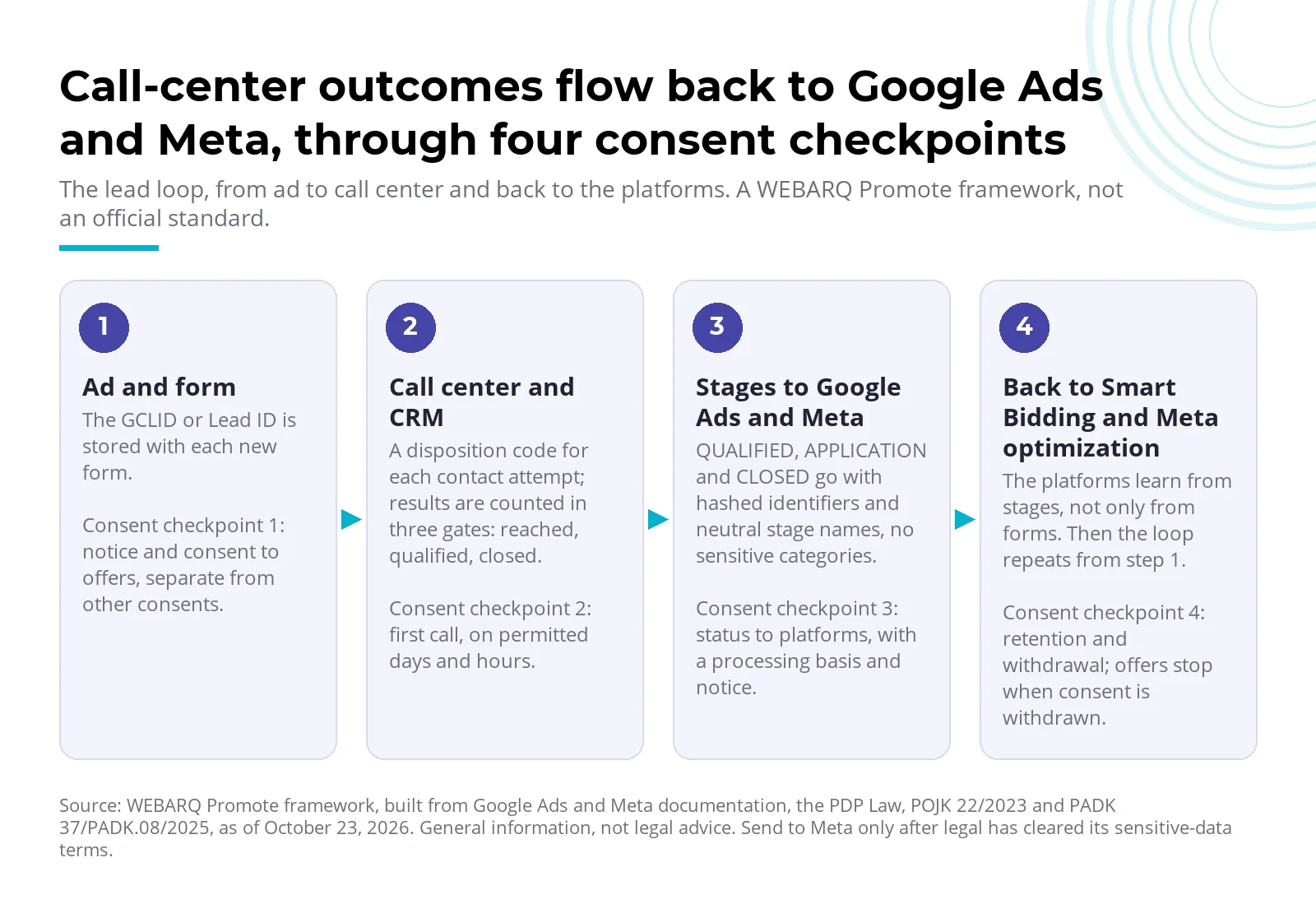
Call-center outcomes flow back through disposition codes. Each CRM status maps to a stage, and the stages that signal quality go to Google Ads as qualified or converted leads and to Meta through the Conversions API for CRM. Without that feedback, both platforms learn only from forms.
As of October 2026, Google Ads' offline conversion import documentation says Smart Bidding optimizes for what's in your Conversions column. Google has two goals for this: qualified leads, which pass qualification in your CRM, and converted leads, typically a sale.
A disposition code is the status an agent records for each contact attempt; these eight are our design, not platform terms.
| # | Code | Meaning | To Google Ads | To Meta |
|---|---|---|---|---|
| 1 | NEW | not yet contacted | measured at the form | Lead ID stored |
| 2 | NOT_REACHED | wrong number or no answer | no | no |
| 3 | REACHED | spoke with the prospect | no | no |
| 4 | NOT_INTERESTED | declines or fails the criteria | no | no |
| 5 | QUALIFIED | criteria confirmed | qualified lead | first positive stage |
| 6 | APPLICATION | awaiting underwriting or credit review | stage in Lead Journey Mapping | middle stage |
| 7 | CLOSED | policy issued or contract booked | converted lead | deepest stage |
| 8 | DECLINED_LATE | withdrawn or declined after applying | no | no |
REACHED stays internal, so platforms don't learn to find people who merely pick up the phone.
Which stage should you optimize for?
Optimize for QUALIFIED, not CLOSED. It's the earliest stage that signals quality, and because it happens sooner and more often than an issued policy, it fits platform time windows more easily. Test it on your own CRM data; limits as of October 2026, subject to change:
- Meta's Conversions API for CRM page (updated October 19, 2026) lists Conversion Leads fit guidelines: Instant Forms (currently the only supported type), at least 200 leads a month, daily uploads, and a stage within 28 days of lead creation converting at 1–40%. The base of the 1–40% isn't defined; ask your Meta rep.
- Google accepts GCLID uploads up to 90 days after the click, or 63 days with hashed user-provided data (enhanced conversions for leads), and advises daily uploads for one to two conversion cycles before bidding on a new goal.
If CLOSED happens after 28 days or outside that range, still send it as the deepest stage and as Google's converted-lead goal, but optimize Meta on QUALIFIED.
What data can you send?
Send only what's needed to match the lead and mark its stage: the GCLID or Meta Lead ID, hashed email and phone, and a neutral stage name.
As of October 2026, Google's customer data policy bars uploading conversion data tied to sensitive categories, including negative financial status (such as a low credit rating) and health information. It also requires telling customers their data is shared for ad measurement, with consent where the law calls for it.
Meta's Business Tools Terms are stricter: shared data must not include or be based on health, financial or consumer-report information, and the rule covers the names and criteria of events, conversions and custom audiences. Events such as "credit_declined" or "medical_passed" are a clear risk even with hashed data, and a neutral name like "stage_2" doesn't help if the stage's criteria rest on financial or health data. Neither platform says whether an underwriting or credit decision falls into those categories; have your Meta rep and legal team confirm before QUALIFIED or CLOSED goes to Meta.
Under Article 4(2) of Law 27/2022 on Personal Data Protection (the PDP Law), health and personal financial data are specific personal data. Article 34(2) lists processing specific data, systematic scoring and data matching as high-risk, requiring a data protection impact assessment (DPIA). Whether your lead scoring is covered is a legal call.
What do the PFI Mega Life, Bussan Auto Finance and Jadiduit case studies show?
Our three case studies show top-of-funnel volume and cost, not lead quality. None reports how many leads were reached, qualified, or became a policy, contract or loan, so they prove nothing about the three-gate framework.
PFI Mega Life, then a new insurer, ran Facebook and Instagram lead-generation campaigns for awareness and education. It reports "twice as many leads/conversions with the proposed setup", a lead conversion cost "1.7 times less than the proposed rate" and "around 800,000 impressions". Baseline, period, lead definition and policy count aren't given.
Bussan Auto Finance, for Yamaha motorcycle financing, reports "an average of 4000 leads per month" and a "cost per install (CPI) of Rp.2500", an app-install cost, not a cost per lead. No CPL or share of financed leads is published.
Jadiduit Gadai is a pawnbroker, not a multifinance company. It reports "approximately 2 million impressions", "around 130,000 clicks" and "about 15,000 conversions", without defining a conversion, a cost or a loan count.
Ask any agency, us included, for contact and qualified rates per campaign and their source system. See also warning signs in digital agencies.
Which rules limit how you collect and use leads?
Three main regulations shape a lead's journey here: the PDP Law, POJK 22/2023 on consumer protection and OJK's PADK 37/PADK.08/2025 on marketing information, plus Google and Meta policies. POJK 22/2023 covers insurers, finance companies and pawnbrokers (Article 2, with Article 1 point 24 for pawnbrokers). The map by touchpoint, as of October 23, 2026:
| Touchpoint | Requirements | Basis |
|---|---|---|
| Ad | Company name or logo and the "licensed and supervised by OJK" statement, without the OJK logo. No superlatives without independent evidence. "Free" (gratis) only with no effort or cost; filling in identity details counts as effort. | Article 35, POJK 22/2023; PADK 37/PADK.08/2025 |
| Form | Notice of purpose, data types, retention period and consumer rights. Consent to phone or message offers, separate from other consents and not a product condition. | Articles 21–22, PDP Law; Article 39(1)–(2), POJK 22/2023 |
| First call | Monday–Saturday except national holidays, 8 a.m.–6 p.m. local time, unless the consumer agrees or asks otherwise. Give the company name, the purpose and, for third-party data, its source. Record offer calls. A general product summary given by phone is delivered orally, before the prospect decides. Insurers must also state the company's identity, the product and the policy terms. | Articles 33(1) and 39(4)–(5), POJK 22/2023; PADK 37/PADK.08/2025; Article 50(2), POJK 8/2024 (insurers) |
| Status to platforms | A processing basis and notice that data is shared for ad measurement; consent to sharing isn't a product condition. Hashed identifiers, neutral stage names, no sensitive categories. | Article 20, PDP Law; Articles 20–23, POJK 22/2023; Google and Meta policies |
| Retention and withdrawal | Consumers can withdraw consent, which stops offers, and ask for deletion. Data of rejected or withdrawn applicants isn't reused without a processing basis. | Articles 22–23 and 39(3), POJK 22/2023; Articles 8–9, PDP Law |
Vendor leads need a written statement that the vendor obtained consent, and the prospect must be told the source (Article 23(3), POJK 22/2023). Breaching Article 39(2)–(8) can bring administrative sanctions, including fines of up to Rp 15 billion (Article 39(9) and (11)). For unit-linked insurance (PAYDI), marketing through personal channels must be followed by a face-to-face meeting or video conference (Article 42(1)–(2), POJK 22/2023; for insurers also Article 50(3), POJK 8/2024).
On-screen rules are covered in POJK 22/2023 read screen by screen.
This article is general information, not legal advice. Check how it applies with your compliance team and legal counsel.
Where do you start in 30 days, and when can you skip it?
Start with measurement, not a new campaign. In 30 days, aim for every lead coded, a cost per qualified lead for every campaign, and the QUALIFIED stage flowing to Google Ads. Meta's CRM route can wait until you meet its fit guidelines and legal signs off.
- Week 1: agree qualified-lead criteria per product with sales. Owner: heads of sales and marketing.
- Week 1: audit ads and forms against the rules table. Owner: marketing and compliance.
- Week 2: add mandatory disposition codes to the CRM and store the GCLID or Lead ID with each new form. Owner: call center and CRM team.
- Weeks 2–3: calculate the three gates and cost per qualified lead per campaign, using performance marketing ROI measurement as common ground with finance. Owner: marketing analyst.
- Week 3: review the processing basis, notices and whether a DPIA is needed. Owner: data protection officer (DPO) or legal team.
- Week 4: upload QUALIFIED to Google Ads daily, then test Conversion Leads on Meta only if you meet its fit guidelines and legal has cleared Meta's sensitive-data terms (see Facebook Ads ad types). Owner: performance team or agency.
Waiting on Meta makes sense if your Instant Forms bring fewer than 200 leads a month, you can't upload daily, QUALIFIED falls outside 1–40% or after 28 days, or legal hasn't cleared the stage's criteria against Meta's sensitive-data terms. Send nothing until the call center logs codes consistently: a wrong signal is worse than none.
Frequently asked questions
What is a quality lead in insurance and multifinance?
A quality lead is one an agent has reached, whose details match written criteria on the call, and that could reasonably become a policy or contract. Measure it with contact rate, qualified rate, lead-to-close and cost per qualified lead. It's a working definition, not an OJK or platform term.
Can we call or WhatsApp a prospect after they fill in a form?
Yes, if consent comes before the offer. Article 39(1) of POJK 22/2023 bans offers through personal communication channels without consent; its explanatory note asks for consent before contacting or before offering. The explanatory note to Article 33(5)(c) counts instant messaging apps as such channels. A form fill isn't named as consent, so the safest route is a separate consent on the form and contact only on permitted days and hours.
What data can you send from the CRM to Google Ads and Meta?
Send matching identifiers (the GCLID or Meta Lead ID, hashed email and phone) and a neutral stage name. Keep rejection reasons, health and financial data, card and ID numbers in the CRM. For Meta, also check that no stage's criteria rest on financial or health data. You need a processing basis and a notice that data is shared for ad measurement.
Do financial services ads on Google need verification?
Yes. As of October 2026, Google requires financial services verification before insurance, credit or loan ads can show in Indonesia. Most licensed advertisers go through the vendor G2RS, then submit the code to Google. Lead-generation agencies for a licensed advertiser count as approved third parties and apply directly, with that advertiser's domain list.
Want these three gates mapped in your own ad accounts and CRM? The WEBARQ Promote Performance Marketing team can set up the codes and data flow with your compliance team.