

Property Developer Lead Generation in Indonesia: From Ad Click to Site Visit



By Della · Updated November 23, 2026
Property developer lead generation in Indonesia often stalls at one point: leads pile up in a spreadsheet while the marketing gallery stays quiet. The ads are rarely the cause. More often the definition of a lead is too loose, every channel is judged by the same number, and the WhatsApp reply arrives the next afternoon.
The fix: measure campaigns to the site visit, not the form fill. Below are a nine-stage funnel model, lead-scoring rules and a follow-up SLA to start from, plus an honest read of our four property case studies.
Key takeaways
- Define a qualified lead as a site-visit-ready lead: it fits on budget, unit type and timeline, and has accepted or asked for a visit slot.
- Judge campaigns by cost per completed site visit. A cheap cost per lead can mean leads who never show up.
- Give each channel one job: Meta creates demand, Google captures intent, video tells the project story, WhatsApp and the CRM convert.
- Set a WhatsApp reply SLA (our recommendation: minutes, in office hours), and hold budget increases until sales can meet it.
Why do so many property leads never turn into site visits?
Because most campaigns aim at form fills, and a filled form isn't intent to buy. Ad platforms find the cheapest form-fillers; they can't tell who will visit the show unit unless you send that signal back.
Google's Performance Max lead generation guidance recommends lead goals such as Submit Lead Form, Book Appointment, Qualified Lead and Converted Lead, and bidding toward deeper-funnel actions where data exists. For lead quality it suggests qualifying questions, reCAPTCHA and server-side validation (accessed November 2026).
At WEBARQ Promote, a qualified lead is a contact who fits the project on budget, unit type and buying timeline, and has accepted or asked for a visit. This is a working definition, not an industry standard. Without one shared definition, the weekly ads-and-sales meeting becomes a fight over "bad leads".
Track cost per site visit, not cost per lead
Cost per site visit is ad spend divided by visits that happened, not visits booked. The hard part is logging each visit and its source in the CRM. The figures below are hypothetical, rounded to show the math, not benchmarks.
| Measure | Campaign A | Campaign B |
|---|---|---|
| Ad spend | Rp 100 million | Rp 100 million |
| Leads | 500 | 200 |
| Cost per lead | Rp 200,000 | Rp 500,000 |
| Completed site visits | 10 | 20 |
| Cost per site visit | Rp 10 million | Rp 5 million |
On cost per lead, A wins easily. On cost per site visit, B is twice as efficient. The rule: judge campaigns at the deepest stage with enough volume to read, usually the site visit. Bookings and signings are often too few for weekly decisions.
Few pages cover this. In a WEBARQ Promote SERP analysis (November 23, 2026, 20 Indonesian-language property marketing queries, DataForSEO, Google Indonesia, desktop, top 10), only 1 of 20 queries had a page one clearly covering lead quality and site-visit conversion, all vendor pages selling a tool. The rest were agent tips, job listings and generic strategy lists. An AI Overview appeared on 19 of 20. Classification rests on titles and snippets, and it's a one-day snapshot.
What does a lead-to-site-visit funnel look like for a developer?
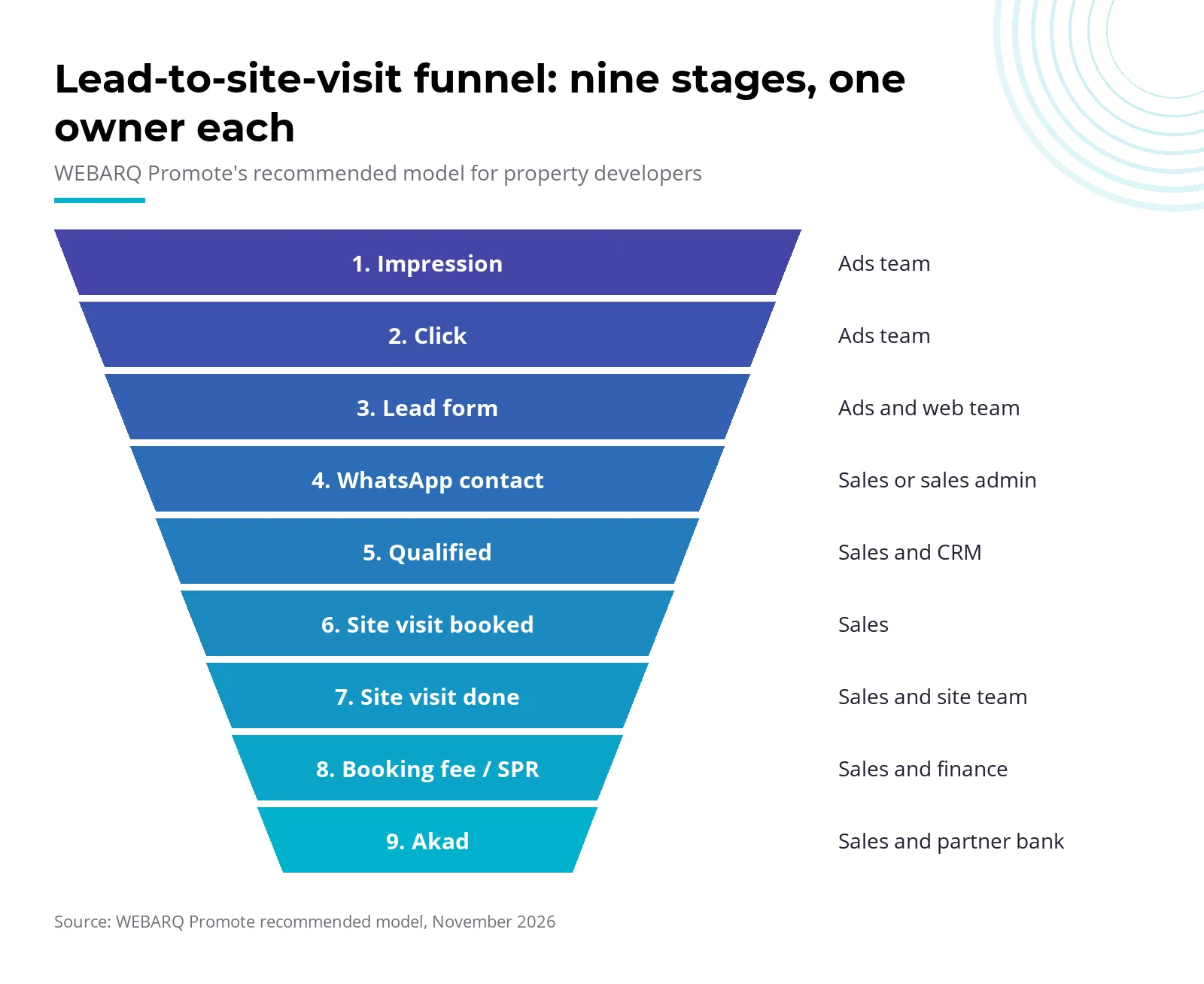
A lead-to-site-visit funnel is nine stages from ad impression to mortgage signing (akad), and each stage has one owner, one metric and one rule. The table is a recommended model from WEBARQ Promote, not a measured or tested result. It draws on Google Ads and Meta documentation, Indonesia's data protection law (UU PDP) and the SERP analysis above (November 2026).
| # | Stage | Owner | Metric | Rule |
|---|---|---|---|---|
| 1 | Impression | Ads team | Reach, frequency | First creative shows location, price range and legal status |
| 2 | Click | Ads team | CTR, landing-page views | Page shows price, unit types, location, track record, one contact action |
| 3 | Lead form | Ads and web team | Submissions, spam share | Name, WhatsApp, unit, budget range, cash or mortgage, UU PDP consent |
| 4 | WhatsApp contact | Sales or sales admin | Share contacted within SLA | First message confirms interest and offers two visit slots |
| 5 | Qualified | Sales and CRM | Share scored warm or hot | Score threshold met; budget, timing and unit fit answered |
| 6 | Site visit booked | Sales | Booked visits per qualified lead | A date, a time and a reminder, not "I'll let you know" |
| 7 | Site visit done | Sales and site team | Show rate | Reminders the day before and on the day; log no-shows |
| 8 | Booking fee / SPR | Sales and finance | Visits that become bookings | Log why a visit stalls: price, mortgage rejection, location |
| 9 | Akad | Sales and partner bank | Signings, mortgage status | Rejection reasons feed targeting and the form |
Stages 4 to 7 belong to sales. Without CRM status per lead, the ads team sees only stage 3 and keeps chasing form fills. Stages 5 to 7 can go back to Google as Qualified Lead or Converted Lead goals where CRM data allows; see our posts on Smart Bidding for lead generation and server-side tracking with the Conversions API.
What job should each ad channel do?
Each channel should hold one job: Meta creates demand, Google captures people already searching, video tells the project story, and WhatsApp plus the CRM turn leads into visits. Trouble starts when all are judged on cost per lead.
| Channel | Job | Signal to chase | Limit |
|---|---|---|---|
| Meta lead ads / click ads | Create demand before people search | Qualified lead, booked visit | Volume isn't intent; needs screening and fast follow-up |
| Meta Click-to-WhatsApp | Open a conversation directly with sales | Qualified chats | Needs a staffed number and a reply SLA |
| Google Search | Capture searches for the project, area or mortgage homes | Leads that pass qualification | Small volume for new projects; start with brand terms |
| Performance Max | Extend reach across Google surfaces | Lead goals, then CRM-based goals | Needs enough conversion data and lead-quality controls |
| YouTube / TikTok | Progress, show unit, neighborhood | Viewer audiences for retargeting | Weak lead intent; support role |
| Property portals | Third-party listing exposure | Visits from portal leads | You don't fully own the lead data or journey |
| WhatsApp and CRM | Reply, screen, book, remind | SLA compliance, show rate, bookings | Only as good as team capacity and data discipline |
The split is our recommendation. For Click-to-WhatsApp, Meta for Developers documentation (accessed November 2026) says these ads run on Facebook, Instagram and Messenger, need a Page linked to a WhatsApp number, and support Engagement, Leads, Sales and Traffic objectives.
A portal listing ad and a developer's own lead engine are two different things. Test both on one measure: cost per site visit.
Advantage+ versus manual is covered in our Meta Ads lead generation guide, the landing page in our lead generation landing page checklist. If you're short-handed, our Paid Social team can run Meta with tracking to the site visit.
What lead-scoring rules make sense?
Five signals are enough for a developer, each scored yes, partly or no, to sort leads into hot, warm and cold. Set weights per project; review them monthly against actual visits. This is a recommended model, not a statistical one.
- Budget: the buyer's budget or monthly installment range overlaps the unit price.
- Location and unit: this area, and a unit type you still have in stock.
- Timing: a plan to buy, say within three months, not "just looking".
- Ready to visit: accepts a visit slot, asks about the show unit, mortgage or booking fee.
- Source: Search and WhatsApp-click leads usually show more intent than broad social leads. Treat that as a hypothesis to test on your visit data.
| Tier | Profile | Action |
|---|---|---|
| Hot | Budget and unit fit, a ready-to-visit signal | Straight to a named salesperson; offer a visit slot that day |
| Warm | Fits, timing unclear | Short follow-up; reconnect when stock or offers change |
| Cold | Budget or unit doesn't fit | One polite message, then keep on file per consent |
On form fields: under Law No. 27 of 2022, personal financial data counts as specific personal data. We recommend asking for a budget range and mortgage plan (yes or no) at the lead stage, and for income documents only at the bank stage.
How fast should WhatsApp replies be, and who owns them?
Our recommendation: a first reply within minutes in office hours, an after-hours auto-reply with a promised time, and a human reply early the next working day. A 5-to-15-minute target is a team choice, not a research finding.
We deliberately don't quote a speed-to-lead statistic. A 2011 Harvard Business Review piece, The Short Life of Online Sales Leads, is often cited, but its abstract says only that most companies respond too slowly. Blog figures derived from it conflict.
| Situation | Target (recommendation) | Owner |
|---|---|---|
| Lead arrives in office hours | First reply within minutes | Salesperson assigned by CRM rotation |
| Lead arrives after hours | Auto-reply, then a human next morning | Sales admin |
| Hot lead | Contacted by a named salesperson the same day | Sales |
| Can't be reached | Three attempts, then stop | Sales or admin |
Ownership matters more than the minute target. Each lead gets one named owner, handoff runs through round-robin CRM assignment (not group-chat screenshots), and a manager checks the "unanswered" list daily. Two salespeople with hundreds of leads a week will break any SLA, so cap the budget first.
UU PDP consent for lead forms and WhatsApp
Lead forms and the first WhatsApp message need a legal basis. Under Law No. 27 of 2022 on Personal Data Protection, one such basis is explicit consent for specific purposes (Article 20). The controller must state the purpose, data types, retention period and the person's rights (Article 21), record consent in writing or otherwise (Article 22), and be able to prove it (Article 24).
If a prospect withdraws consent, processing must stop within 3 x 24 hours (Article 40). Breaches can bring administrative sanctions, including a fine of at most 2% of annual income or revenue relating to the violation variable (Article 57).
Our practical reading: the consent line names WhatsApp contact by sales and any sharing with agents or partner banks. The first message names the project, the sender and how to opt out.
What do our property case studies show?
Our four property case studies report impressions, clicks and leads from Meta and Google, but none publishes cost per lead, site visits or sales. Figures are quoted as published.
| Client | Channels | Published results | What it doesn't show |
|---|---|---|---|
| Tiara Hana (luxury villa investment, Bali & Lombok) | Google Search, Performance Max, YouTube, TikTok | "around 2.2 mill Impression", "around 30k Click ... each month", "around 376k View", "around 2K Conversion" | Definition of "conversion", cost per lead, visits, sales |
| Crown Group (Australian apartments, Indonesian investors) | 40% of budget on Facebook, 60% on Instagram; video as core creative | "approximately 5 million impressions", "around 90,000 clicks" | Lead count and quality, cost, visits, what the targets were |
| Skyhouse (apartments) | Facebook and Instagram, 50/50 | "over 100 leads each month", "around 800,000 impressions each month" | Cost per lead, lead quality, visits, budget size |
| The White Lyst (Australian property management) | Instagram only, video | "approximately 300,000 impressions", "around 1,400 clicks", "around 125,000 views" | Leads, cost; a management service, not a developer |
Three cases target investors; none reflects Indonesian mortgage buyers of landed homes. They show these channels can produce reach and leads for property, no more. Your cost per site visit comes only from your own data.
When should you not raise ad budget?
Hold the budget if stock, price, legal paperwork or sales capacity isn't ready. Ads speed up what exists; they don't fix a product that isn't ready to sell.
If the most-requested unit type is sold out, ads collect leads for units you can't sell. A price that doesn't fit the local market raises cost per site visit, however good the creative. Legal documents (land certificate, PBG building approval) should be clear and ready to show before you push traffic.
Offers built on LTV and VAT incentives have expiry dates
Loan to value (LTV) is the share of a property's value a bank may finance. PADG No. 30 of 2025 sets the relaxed LTV/FTV limits until December 31, 2026. After its October 20 to 21, 2026 board meeting, Bank Indonesia announced that 100% LTV/FTV for all property types runs to December 31, 2027, only for banks meeting certain NPL/NPF criteria. That isn't "zero down payment for everyone": approval still follows each bank's credit check.
On government-borne VAT (PPN DTP), under PMK No. 90 of 2025 (Articles 4 and 7), the 100% incentive covers new landed houses and new apartment units handed over ready to occupy in 2026, with a selling price of at most Rp 5 billion, applied to the VAT on the first Rp 2 billion of the price. The finance minister announced an extension to December 31, 2027 (Kontan, October 14, 2025), but as of November 2026 we found no regulation for 2027. Check current rules before putting either incentive in ad copy.
How should you judge an agency on a property campaign?
Judge an agency by its willingness to be measured to the site visit, not cost per lead. Reports that stop at impressions and form fills use the easiest number to hit. Three questions for the first meeting:
- Is CRM status (qualified, site visit) sent back to Meta and Google as a goal?
- Which channel gets cut if its cost per site visit is the highest?
- If sales can't meet the SLA, what's the move: more leads, or hold the budget?
The right answer to the last one: hold the budget.
First steps this week
Write a one-sentence qualified-lead definition and agree it with the head of sales. Add "site visit booked" and "site visit done" fields, with lead source, to the CRM. Then calculate last month's cost per site visit by channel, even if the data is messy. That number shows which channel deserves more budget.
This article is general information, not legal or financial advice. BI rules, PMKs and UU PDP can change.
Frequently asked questions
What is a qualified property lead?
In our working definition, a qualified lead fits the project on budget, unit type and buying timeline, and has accepted or asked for a site visit slot. It isn't an industry standard; what matters is that ads and sales share one written CRM definition.
How much should a developer spend on property ads each month?
No figure fits every project. Work backward: the site visits you need, divided by your show rate, divided by your lead-to-booked-visit rate from your own data, multiplied by your cost per lead. No data yet? Run a one- to two-month test on a small budget.
Should a developer start with Meta or Google ads?
Start from what the project needs. Search captures people already looking for the project, the area or a mortgage home, but volume is small for a new project. Meta creates demand among people not yet searching and needs heavier screening. Both can run together if both are judged on cost per site visit.
How fast should a property lead get a reply?
Our recommendation: a first reply within minutes in office hours, an after-hours auto-reply with a promised time, then a human reply the next morning. We don't quote a speed-to-lead statistic because published figures conflict. Budget should follow the team's capacity to hit that target.
Do developers still need property portals?
A portal is a channel with its own job: exposure to buyers comparing listings. Unlike your own form and WhatsApp number, you don't fully own the lead data or journey. Measure portals on cost per site visit, like any channel, and set their share from that.
Want property campaigns measured to the site visit, not the form? The WEBARQ Promote Performance Marketing team can set up channel roles, CRM tracking and cost-per-site-visit reporting.