

Meta Ads for Lead Generation in 2026: When to Trust Advantage+ and When to Stay Manual


By Della · Updated November 4, 2026
For Meta ads lead generation, an Advantage+ leads campaign is a sensible default when your audience is broad and you can give up placement control. Manual campaigns remain the safer choice for narrow markets, financial products, or teams that can't yet measure lead quality in a CRM.
The deciding factor isn't taste. It's the thresholds Meta publishes itself: optimizing for qualified leads through your CRM takes at least 200 leads a month, daily data uploads, and a sales stage reached within 28 days.
Key takeaways
- Advantage+ leads automates audience, placements, and campaign budget together. The "Advantage+ On" status disappears once you lock placements at ad-set level.
- Meta reports that Advantage+ leads averages a 14% cheaper lead and a 10% cheaper qualified lead, with no study conditions shown. Don't treat that as a target for an Indonesian account.
- The Conversion Leads goal works only with instant forms and suits accounts with 200+ leads a month, a CRM stage reached within 28 days, and a 1-40% rate for that stage.
- Measure cost per qualified lead in the CRM. A falling cost per lead (CPL) can simply mean your sales team is calling more numbers that never pick up.
What does Advantage+ actually automate in a leads campaign?
An Advantage+ leads campaign is a leads-objective campaign that hands audience, placements, and campaign budget to Meta's automation. According to Meta's Advantage+ leads page, it is on by default for leads campaigns in Ads Manager (checked November 4, 2026). Meta's Indonesian-language page keeps the English name: "kampanye prospek Advantage+".
The same page claims that, averaged across advertisers, Advantage+ leads cuts cost per lead by 14% and cost per qualified lead by 10%. No period, sample, or country is shown. Social Media Today, which covered the global rollout of Advantage+ leads on October 30, 2025, noted that results will vary.
Advantage+ leads vs a manual lead ads campaign
A campaign counts as "Advantage+ On" only when three conditions hold at once: Advantage+ campaign budget stays on, at least one ad set uses Advantage+ audience, and every ad set runs on all placements. Here is how the two compare, per Meta's Marketing API documentation and the Advantage+ leads page (read November 4, 2026):
| Aspect | Advantage+ leads | Manual leads campaign |
|---|---|---|
| Audience | Interests, custom audiences, and lookalikes act as suggestions only | You set detailed targeting, lookalikes, and location rules |
| Exclusions | Custom-audience exclusions only | Audience and placement exclusions at ad-set level |
| Placements | All placements, except those excluded at account level | You choose per ad set |
| Budget | Campaign level | Ad-set level allowed |
| Form type | Instant forms and website forms | Same |
What you still control
Creative, the offer, form questions, and account-level exclusions stay with you. Advantage+ creative, which optimizes visuals, text, and audio, is a separate switch.
When is Advantage+ worth it, and when should you stay manual?
Use Advantage+ leads when you sell to a general consumer audience aged 18+, can accept every placement, and can live with custom-audience exclusions only. Stay manual when your product or market needs audience and placement control at ad-set level, or when lead volume is too small to read the results.
Decision matrix for Meta ads lead generation (WEBARQ Promote analysis of Meta documentation, November 4, 2026; method: reading Meta's Advantage+ leads page, Marketing API documentation, lead form page, Conversion Leads guide, and financial products ad policy)
| Factor | Leans to Advantage+ leads | Leans to manual | Basis |
|---|---|---|---|
| Monthly lead volume | Meta states no minimum volume for Advantage+ leads | With few leads in a narrow market, a tight manual structure is easier to read | Meta docs; right cell is a WEBARQ Promote judgment |
| CRM-based optimization | The 200+ leads a month threshold applies to the Conversion Leads goal, in either structure | Same | Meta's Conversion Leads guide |
| Monthly budget | No rupiah minimum in the docs; budget must sit at campaign level | Ad-set budgets allowed, but many small ad sets thin the data | Meta docs; right cell is a WEBARQ Promote judgment |
| Audience and placement control | Audience suggestions and custom-audience exclusions are enough | You need ad-set placement exclusions, detailed targeting, or location rules | Meta's Marketing API docs |
| Financial products | The same Meta policy applies: 18+ targeting for credit cards, loans, and insurance | Better fit when compliance requires controlled placements or exclusions | Meta ad policy; right cell is a WEBARQ Promote judgment |
| Form type | Instant and website forms supported | Same; Conversion Leads works on instant forms only | Meta's lead form page |
If in doubt, run both with the same offer and form for one sales cycle, then compare cost per qualified lead in the CRM (our judgment).
Why does a cheap CPL so often mean poor leads?
A cheap CPL often means the form is too easy, so Meta learns to find people who like submitting forms rather than likely buyers. The algorithm chases whatever event you give it. If that event is just "form submitted", you are optimizing for volume.
Meta's own numbers show the pull toward volume. On Meta's lead form page, advertisers who ran website forms alongside instant forms averaged a 60% lower CPL and up to 125% more leads than with website forms alone. No study conditions are shown, and the figures measure cost, not lead quality.
The arithmetic shows the trap (illustrative figures, not a benchmark):
| Campaign | CPL | Pass qualification | Cost per qualified lead |
|---|---|---|---|
| A, instant form with no screening questions | Rp 50,000 | 5% | Rp 1,000,000 |
| B, form with two screening questions | Rp 120,000 | 20% | Rp 600,000 |
Campaign B looks more expensive in Ads Manager, yet it's cheaper where it counts. The levers on the Meta side:
- Screening questions on the instant form, such as budget range or purchase timing.
- Verification options Meta has announced, per Social Media Today (October 30, 2025): SMS phone verification and require work email (via Instagram or the Marketing API). Check your Indonesian account for them.
- A website form for decisions that need full information. For the page structure, see our lead generation landing page checklist.
How do you connect your CRM to Meta so it optimizes for qualified leads?
Send lead status from your CRM back to Meta through the Conversions API, then choose the Conversion Leads goal, so Meta optimizes for a sales stage rather than a submitted form. According to Meta's Conversion Leads guide, this works only with lead ads that use instant forms.
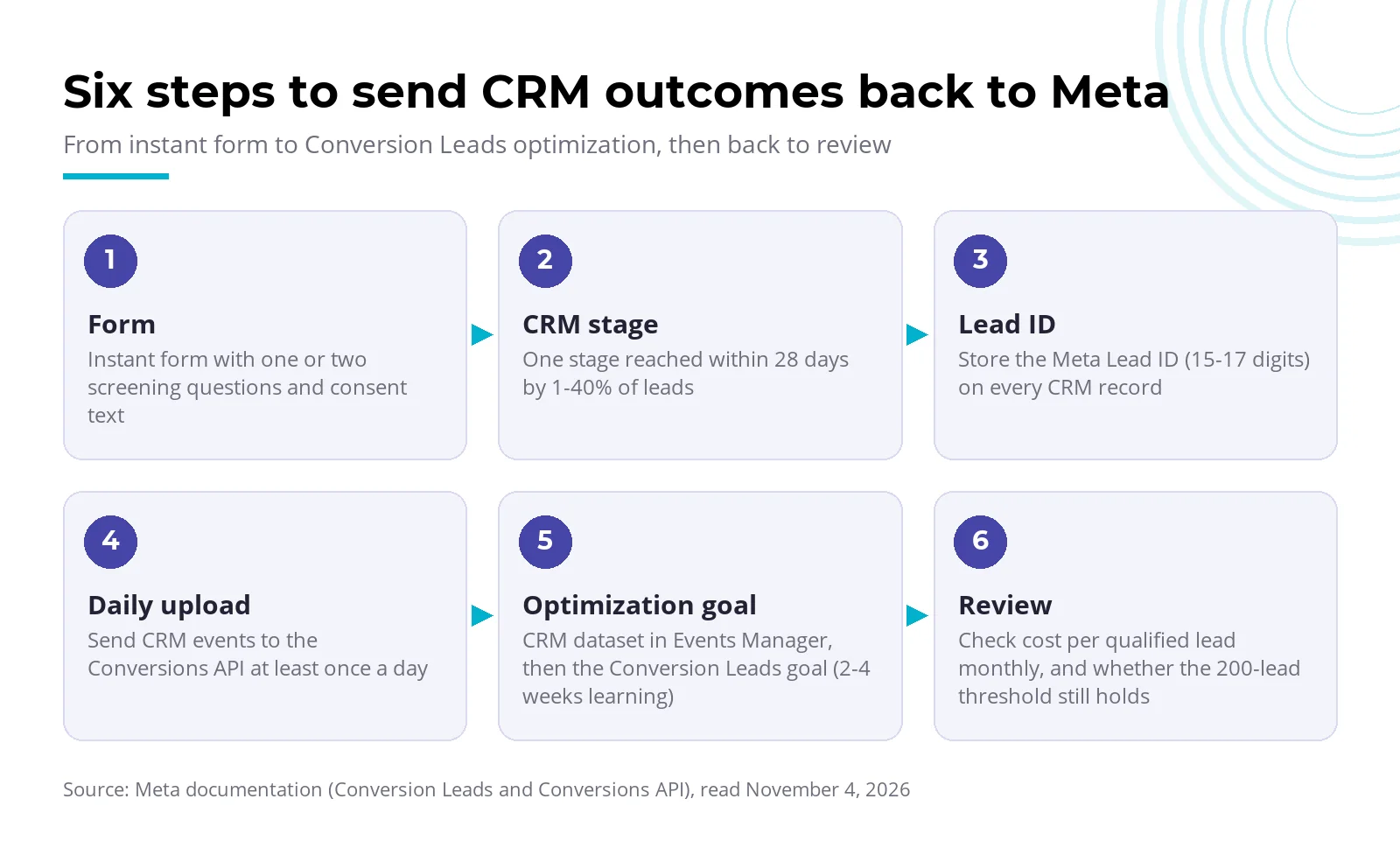
Six steps, per Meta's documentation (November 4, 2026):
- Form. Use an instant form, add one or two screening questions, and include clear purpose and data-processing consent text.
- CRM stage definition. Pick one stage, for example "verified by sales", that is reached within 28 days of the lead coming in and by 1-40% of leads.
- Lead ID. Store the Meta Lead ID (15-17 digits) on every CRM record, or send a click ID, phone number, or email if it's missing. This assumes Meta leads already flow into the CRM.
- Daily upload. Send CRM events at least once a day. Per Social Media Today (2025), Zapier users can push as many as 100,000 lead events into the Conversions API at no cost.
- Optimization goal. Create a CRM dataset in Events Manager, then choose the Conversion Leads goal. Learning takes 2-4 weeks; full value shows after about 3-4 weeks.
- Review. Check cost per qualified lead and stage rates in the CRM monthly, and whether the 200-lead and 1-40% conditions still hold.
According to Meta's CRM integration getting-started page, you don't need the CRM integration to start using the Conversion Leads goal, but results improve once it's connected. The Advantage+ leads page reports, on average, a 15% lower cost per quality lead and a 44% higher lead-to-quality-lead rate with the CRM setup versus the standard performance leads goal. Again, no conditions are given.
Two of our case studies give a sense of scale. The Skyhouse campaign on Facebook and Instagram generated over 100 leads each month, still below 200. Bussan Auto Finance reached an average of 4,000 leads per month with a full-funnel setup that included Facebook and Instagram. Neither covers Conversion Leads; the numbers serve only as a volume comparison.
What should banks, multifinance firms, and fintechs watch for?
Financial institutions need to check two layers of rules before choosing Advantage+: Meta's ad policy for financial products and Indonesia's Personal Data Protection Law. They limit who you target, what you ask for, and what goes back to Meta.
Under Meta's ad standard for financial and insurance products, advertisers may need to show a license from the regulator in the country they target. Ads for credit cards, loans of more than 90 days, and insurance must target people 18+ and must not directly request financial data such as bank account or card numbers. Loans of 90 days or less are prohibited. Check in Ads Manager whether a special ad category with extra audience limits applies; our sources don't cover Indonesia.
On the data side, Law No. 27 of 2022 touches the lead flow at several points:
- Article 20(1) and (2)(a): every act of processing needs a legal basis, one of which is valid explicit consent for a specific purpose.
- Article 21(1): when relying on consent, data subjects must be told the purpose, type of data, retention period, and their rights.
- Articles 24 and 28: the controller must be able to show proof of consent, and processing must match the stated purpose.
- Article 56: transfers outside Indonesia are allowed. The controller must make sure the receiving country's protection is equal to or higher than the law's; failing that, adequate and binding safeguards are needed; failing both, the data subject's consent.
The law classes personal financial data as specific personal data. Our judgment at WEBARQ Promote: sending CRM status to Meta is an extra processing purpose for the consent text, and a transfer abroad for your legal team to assess. For the sales-process side, see our piece on lead quality for insurance and multifinance.
This section is general information, not legal advice.
A 30-day checklist before you raise the budget
In the first 30 days, the goal is data you can trust, not the lowest CPL.
| Week | What to do | Done when |
|---|---|---|
| 1 | Choose the CRM stage to optimize for; rewrite the form's consent text | The stage is reached within 28 days at a 1-40% rate |
| 2 | Connect Meta lead downloads to the CRM and store the Lead ID | Every new CRM lead carries a Lead ID |
| 3 | Launch an Advantage+ leads campaign and a manual one with the same form | Both run on comparable budgets and forms |
| 4 | Compare cost per qualified lead and decide next quarter's structure | A written decision, with the CRM numbers behind it |
Above 200 leads a month, add daily CRM event uploads in week two. Below it, hold off on Conversion Leads and work on screening questions. We cover the Ads Manager basics in our Facebook Ads guide.
Frequently asked questions
What is the difference between Meta Ads and Facebook Ads?
They are the same product. Facebook Ads is the older label; Meta Ads are built in Meta Ads Manager and run on Facebook and Instagram. For lead generation, results depend on the campaign structure (Advantage+ leads or manual) and the form type: instant or website.
Is Advantage+ a good fit for B2B lead generation?
It's worth testing, with limits. In Advantage+ mode, interests and lookalikes work only as suggestions and ad-set exclusions are limited to custom audiences, while narrow B2B markets often need that control. Meta hasn't published B2B-specific evidence, so judge the result by cost per qualified lead in your CRM, not by CPL.
How many leads do you need for Conversion Leads optimization?
Meta's good-fit conditions: at least 200 instant-form leads a month, CRM data uploaded at least daily, and an optimized stage reached within 28 days at a 1-40% rate. Below 200 leads a month, optimizing for the standard lead event is usually more realistic.
Instant form or landing page: which is better?
Instant forms win on volume because they are fast and prefilled, while website forms suit bookings or decisions that need full information. Meta suggests running both. But the Conversion Leads goal only works with instant forms. If you send traffic to a landing page, the page itself largely sets your cost per lead.
What starting budget does a Meta lead campaign need?
The Meta documentation we read gives no rupiah minimum for leads campaigns, so ignore the daily figures that circulate online. Aim for enough leads each month to judge in your CRM, and note that Advantage+ keeps the budget at campaign level. To build the numbers, see our 2027 marketing budget worked example.
Do you need customer consent to send CRM data to Meta?
Law No. 27 of 2022 requires a legal basis for all processing, and explicit consent is one of them. If you rely on consent, state the purpose, keep proof, and follow Article 56 for transfers abroad. This is general information, not legal advice.
Want to know whether your account is ready for Advantage+ and CRM-based optimization? The WEBARQ Promote Paid Social team can map your campaign structure and data flow together with your sales team.