LinkedIn Ads for B2B and Banking in Indonesia: Targeting, Costs and Lead Gen Forms



By Della · Updated November 22, 2026
LinkedIn Ads are worth it for Indonesian B2B and banking teams when the buyer can be defined by a job title: a finance director for cash management, an HR head for payroll, an IT decision-maker for software. For credit cards, savings accounts or mortgages, the same money usually works harder on Meta or Google Search. The entry price is low: per LinkedIn's documentation (November 2026), the minimum daily budget is USD 10, about Rp 182,780 at Bank Indonesia's JISDOR rate of November 20, 2026. Audience size and sales follow-up decide the rest.
Key takeaways
- LinkedIn requires at least 300 member accounts and suggests 50,000 or more; one help page says 300,000 for Sponsored Content.
- Campaign Manager's default suggestion for new advertisers is USD 25 a day, about Rp 13.7 million a month.
- LinkedIn publishes no CPC or cost-per-lead benchmark in the documentation we read, so cost targets must come from your own tests.
- Audience expansion and LinkedIn Audience Network switch on automatically in many ad sets. Turn both off for lead campaigns aimed at a narrow account list.
- Bank ads must carry the bank's name or logo and a statement that it is licensed and supervised by OJK (Article 35, POJK 22/2023), without the OJK logo.
Are LinkedIn Ads worth it for B2B and banks in Indonesia?
Yes, for products where the purchase is tied to a role and a company rather than to age or interests: corporate banking, cash management, payroll, treasury, priority banking, B2B fintech and SaaS. Mass retail products don't qualify.
The reason is the data. According to LinkedIn's targeting options page, job function and seniority are mapped from the titles members enter, using LinkedIn's own taxonomy with no AI modeling. Industry comes from the employer, so a bank employee sits under "Banking".
When LinkedIn beats Meta, and when it doesn't
The table separates documented capabilities from our judgment.
| Dimension | LinkedIn Ads | Meta Ads | Google Search |
|---|---|---|---|
| Targeting basis | Job title, function, seniority, industry, company size and name, skills, Matched Audiences (LinkedIn docs) | Custom audiences, lookalikes, detailed targeting; job-title precision not verified by us | Intent from the keyword typed |
| User mindset | Reading a professional feed, not searching | Reading a personal feed | Searching for a solution now |
| Entry budget | USD 10 a day | Not researched here | Not researched here |
| Best for (WEBARQ judgment) | Narrow, high-value audiences that clear LinkedIn's size guidance | Retail banking products, broad reach, lead volume | Existing demand, such as a search for "corporate payroll" |
For retail leads, see our comparison of Advantage+ and manual setups in Meta Ads. Note that Meta's Special Ad Category for financial products, which removes lookalikes, has been mandatory since January 14, 2025 for campaigns located in or shown to the United States; Indonesia isn't named.
Duitku, a payment gateway growing its B2B client base, used Google Ads Search and Display, and its case study reports "about 17,000 conversions from the overall campaign." A B2B product doesn't automatically mean LinkedIn.
How do you size a LinkedIn audience in Indonesia?
Build the audience in Campaign Manager, read the forecast panel, and compare it with LinkedIn's thresholds. National statistics won't help: LinkedIn's audience page cites more than 1 billion members in 200 countries and territories, 277 million of them in Asia-Pacific, with no per-country figure.
We don't use third-party Indonesian figures. LinkedIn's own guidance varies by page.
| Threshold | Number | LinkedIn source |
|---|---|---|
| Minimum to run a campaign | 300 member accounts | Help page and audience page |
| Suggested minimum "to drive results" | 50,000 | Audience size help page |
| Single image and text ads, optimal scale | 50,000 or more | Audience page |
| Message Ads, optimal scale | Over 15,000 | Audience page |
| Sponsored Content and Sponsored Messaging | 300,000 | Audience size help page |
| Text ads | 60,000 to 400,000 | Audience size help page |
How we read it: 300 is the technical floor, 50,000 the working benchmark, and 300,000 a sign that LinkedIn sees anything smaller as small for Sponsored Content.
Values inside one facet widen the audience (OR); another facet under "narrow audience" shrinks it (AND). Record the forecast after each step:
- Location (required): Indonesia, or cities if you only serve Greater Jakarta.
- Company industry, such as manufacturing or retail.
- Company size.
- Job function, for example Finance or Human Resources.
- Seniority, for example Director, VP and CXO.
Under 50,000, loosen one facet or treat the campaign as retargeting and account-based marketing. A list of a few hundred target companies will almost certainly land below that benchmark (our judgment). Upload it as a Matched Audience well above 300, since the location filter can push it under the minimum.
The forecast excludes audience expansion. LinkedIn's ad policy also bans targeting on sensitive categories such as income, so "high-income customers" is off limits.
What is the minimum and realistic budget in rupiah?
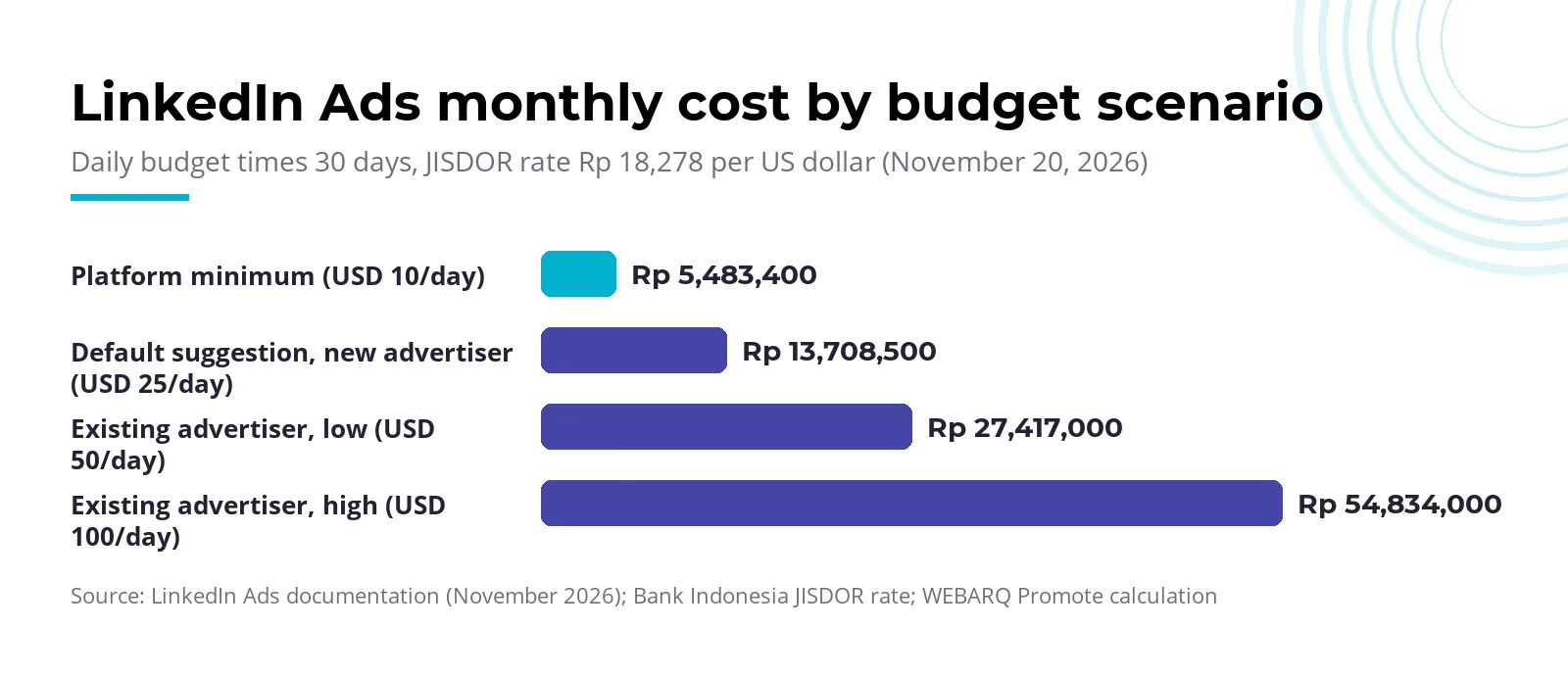
The minimum is USD 10 a day, per LinkedIn's budget page. Campaign Manager suggests USD 25 a day for new advertisers and USD 50 to 100 for existing ones. Those are defaults, not a promise of results.
WEBARQ Promote budget worksheet. Method: dollar figures from LinkedIn documentation we read on November 22, 2026, multiplied by Bank Indonesia's JISDOR rate for November 20, 2026, Rp 18,278 per US dollar. A month is 30 days. The 28-day test is our choice, not a LinkedIn rule.
| Scenario | Per day (USD) | Per day (Rp) | 28 days (Rp) | 30 days (Rp) |
|---|---|---|---|---|
| Platform minimum | 10 | 182,780 | 5,117,840 | 5,483,400 |
| Default suggestion, new advertiser | 25 | 456,950 | 12,794,600 | 13,708,500 |
| Default suggestion, existing advertiser (low) | 50 | 913,900 | 25,589,200 | 27,417,000 |
| Default suggestion, existing advertiser (high) | 100 | 1,827,800 | 51,178,400 | 54,834,000 |
| Minimum lifetime budget, new campaign | - | - | 1,827,800 total | - |
LinkedIn recommends a lifetime budget with lifetime pacing, which spreads spend across a week of predicted activity.
There are three bidding strategies, per LinkedIn's bidding page: maximum delivery (automated, charged per impression), cost cap (you set a target cost per result) and manual bidding. Maximum delivery starts with a learning phase, so first-week numbers swing.
Our judgment: USD 25 to 50 a day split across four audiences and five creatives leaves none with enough data. Start with one audience and two or three creatives, and set no lead-count target before the first test data arrives.
Which ad format fits which goal?
For B2B leads, pair Sponsored Content with a Lead Gen Form. Message Ads suit event invitations or follow-ups to people who know you.
Sponsored Content is LinkedIn's in-feed ad unit: single image, carousel, video or document. The document format suits a bank's research or economic outlook. Message Ads are ads delivered as messages in LinkedIn Messaging, with a smaller scale guide of over 15,000 members.
A Lead Gen Form is a form inside LinkedIn, pre-filled from the member's profile. If you use a landing page instead, run through our lead generation landing page checklist.
How do you set up a Lead Gen Form for quality leads and PDP Law compliance?
Use three or four fields, one qualifying custom question, privacy text carrying what the PDP Law asks for, and a separate checkbox for marketing consent. The limits, per LinkedIn's Lead Gen Form fields page and its specifications page:
- Up to 12 fields including custom questions. LinkedIn recommends three or four.
- Up to three custom questions, which members must answer.
- A privacy policy URL is required, plus optional privacy text of up to 2,000 characters.
- Up to five consent checkboxes of 500 characters each, outside the 12-field count.
- Up to 20 hidden fields for tracking values such as UTM source.
On its marketing blog, LinkedIn claims an average Lead Gen Form conversion rate of 13% against 4.02% for landing pages, citing an Unbounce study. It's undated and gives no method: a vendor claim.
Pre-fill raises volume, and easy volume usually lowers quality (our judgment). A custom question such as "How many employees would you enroll in payroll?" beats an extra field. Send test leads to your CRM before launch, and have sales report lead status back weekly.
On the legal side, Law No. 27 of 2022 on Personal Data Protection (the PDP Law) has applied in full since its transition period ended on October 17, 2024. Article 20(2)(a) lists "explicit valid consent" as one legal basis for processing. Article 21(1) requires you to inform the data subject of, among other things, the legality, purpose, type of data, retention period, processing period and their rights.
Consent for other purposes must be clearly distinguishable (Article 22(4)), and consent that misses these terms is void by law (Article 22(5)). The privacy text and separate checkboxes can be used to meet those requirements, but they don't make you compliant by themselves; that depends on what you do with the data after download. Breaching Articles 20 and 21 risks administrative sanctions, including a fine of up to 2% of annual revenue tied to the violation (Article 57).
Special rules for banks and financial products
LinkedIn's Advertising Policies list financial services as a restricted category: lending, mortgages, credit, investments, financial trading, insurance and pensions. We found no Indonesia-specific LinkedIn requirement.
Local rules go further. Article 35(1) of POJK 22 of 2023 requires every promotion or ad to carry the name and/or logo of the financial services business (PUJK) and a statement that it is licensed and supervised by OJK. The OJK logo may not be used in that statement, and fines reach Rp 15 billion. Article 29 requires product information in Bahasa Indonesia (a foreign language may supplement it), so check English-only creative with compliance.
PADK 37/PADK.08/2025, in force since December 2, 2025 with a six-month adjustment period (to around June 2026), holds the bank responsible for what third parties, agencies included, deliver, and requires it to document ad material. If the bank also sponsors creators, read our explainer on OJK's financial influencer rule, POJK 6/2026.
POJK 22/2023 binds PUJK; a software vendor or B2B fintech outside that definition answers to its own regulator. For the wider channel picture, see our digital marketing playbook for banks in Indonesia.
Which mistakes waste the most LinkedIn Ads budget?
The costliest mistakes are defaults nobody changed, which quietly widen a carefully narrowed audience.
Audience expansion is on automatically in ad sets that support it, and LinkedIn positions it for the upper funnel. LinkedIn Audience Network also turns itself on for new single image, video, carousel and document ad sets, sending ads to third-party sites and apps. Both suit awareness; for leads from a narrow account list, we turn both off.
Other mistakes are simpler: a brand awareness objective used to chase leads, leads left in a CSV with no CRM feedback, and ad sets created on launch day although LinkedIn suggests 48 hours ahead.
For banks, LinkedIn's Insight Tag guidance bars the tag from pages that collect or contain sensitive data, including consumer pages for certain financial services. A generic homepage and B2B pages are fine; account and transaction pages are not.
Our rule of thumb: under 50,000, use LinkedIn for retargeting and account-based marketing. Over 50,000 with a corporate product, run a 28-day test at the default budget. For retail products, put the money into Meta or Search. This article is general information on Indonesia's PDP Law and OJK rules, not legal advice.
Frequently asked questions
What is LinkedIn Ads?
LinkedIn Ads is LinkedIn's self-serve advertising platform, run through Campaign Manager. You choose an objective, audience, format and budget and pay through an auction. Its strength is targeting on professional and company data such as job function, seniority, industry, company size and named companies.
What is the minimum LinkedIn Ads budget in rupiah?
Per LinkedIn's documentation (November 2026), the minimum daily budget is USD 10 for every ad format, about Rp 182,780 at Bank Indonesia's JISDOR rate of November 20, 2026 (Rp 18,278 per dollar). A new campaign on a lifetime budget needs at least USD 100. That is a floor, not a recommendation.
Are LinkedIn Ads a good fit for banks?
Yes, for products bought by a specific role: cash management, payroll, treasury, corporate lending or priority banking. For mass retail products, Meta and Google Search usually make more sense. Financial services are a restricted category in LinkedIn's ad policies, and bank ads in Indonesia must still meet Article 35 of POJK 22/2023.
Do Lead Gen Forms make data collection compliant with Indonesia's PDP Law?
Not on their own. Lead Gen Forms offer a required privacy policy URL, up to 2,000 characters of privacy text and up to five consent checkboxes. These can carry the information Article 21 of the PDP Law requires and separate extra purposes such as marketing contact, but compliance depends on how you process the data afterward.
LinkedIn or Meta for B2B leads?
In our view, LinkedIn wins when the buyer can be defined by job title, industry and company size, and that audience clears LinkedIn's 50,000-member guidance. Meta is better for broad reach and consumer products. If buyers are already searching for the solution, Google Search captures that demand more directly.
Is your audience big enough for LinkedIn, or does the money belong on Meta? Our Paid Social team at WEBARQ Promote can size the audience, set a test budget and build a Lead Gen Form your compliance team can review.