
OJK Regulation 6/2026: Financial Influencer Rules for Banks and Fintechs Before December 4



By Della · Updated October 30, 2026
Banks, multifinance companies and fintechs already working with influencers have until December 4, 2026 to align those partnerships with the OJK financial influencer regulation, POJK 6/2026. That date is our calculation: Article 16 allows six months from promulgation on June 4, 2026. The transition covers only partnerships that existed before June 4, 2026. Anything signed since then gets no Article 16 grace period. Most of the compliance load sits with the financial services business (PUJK), which is responsible for the information its influencers deliver.
Key takeaways
- Partnerships from before June 4, 2026 must be aligned by December 4, 2026 (our calculation).
- PUJKs carry eight duties under Article 7(2). A breach can bring seven forms of sanction, including a fine up to Rp 15 billion.
- The text names no fine amount for influencers. Their route is guidance, a Written Order and takedown, but deliberately ignoring a Written Order brings criminal sanctions under the OJK Law.
- BNPL content must state that the product is risky. Stock and digital financial asset content must state that it is high risk. Both add two disclaimers.
What is POJK 6/2026 and who does it cover?
POJK 6/2026 governs the conduct of financial-sector information providers (Penyampai Informasi): any party other than a PUJK that delivers financial information to raise literacy or to influence consumers to use a product.
Enacted on May 26, 2026, it took effect when promulgated on June 4, 2026. June 24 is the press release date, not the effective date. Don't confuse POJK 6/2026 with POJK 6/POJK.07/2022 on consumer protection, which surfaced in the same search results when we checked.
Article 5 sets three activity types:
- Education: avoids specific product brands and does not sell.
- Marketing: information on specific products, in cooperation with a PUJK (Article 7).
- Recommendation: advice to use or not use specific products, without a PUJK deal (Article 8).
By our reading of the elucidation to Article 5, a paid influencer campaign featuring a specific bank product is marketing, even when it feels like education. Investortrust reported that at a July 10, 2026 discussion, OJK officials said influencers must state their role and that OJK can examine what their content actually does. No article of the regulation sets out that role declaration.
What must a PUJK bring into line before December 4, 2026?
A PUJK needs all eight Article 7(2) duties working in every active partnership. The regulation does not spell out contract terms, so the last two columns are our advice, not OJK requirements.
Obligations matrix. WEBARQ Promote analysis of the text of POJK 6/2026, October 30, 2026. Method: full reading of body and elucidation, cross-checked against the OJK FAQ.
| Article | Bound party | Duty | Contract item | Content check |
|---|---|---|---|---|
| 2(d)-(e) | Influencer | No profit promises that don't fit the product; balanced comparisons only | Banned-claims list | No "guaranteed profit" or "best" without analysis |
| 7(2)(a), 7(4) | PUJK, influencer | Name and PUJK relationship stated first | Mandatory disclosure line | Up front, every format |
| 7(2)(b) | PUJK | Only products in the agreement | Product schedule | No other products |
| 7(2)(c) | PUJK | Product is OJK-licensed | License status in brief | License checked at approval |
| 7(2)(d) | PUJK | Influencer has skill, competence and/or qualification | Credentials, audience data on file | Followers fit the product |
| 7(2)(e) | PUJK | No misuse of consumer data; data protection rules followed | Leads only through PUJK systems | Links go to PUJK channels |
| 7(2)(f) | PUJK | Provide complete product information, including benefits and risks | Information pack attached | Matches the pack |
| 7(2)(g) | PUJK | Responsible for what the influencer delivers | Approval flow, correction clause | Approval record per post |
| 7(2)(h) | PUJK | Periodic evaluation | Reporting and review dates | Monitoring log |
The elucidation to Article 7 names pre-publication review as one way to comply ("among others"), so the method isn't fixed. Still, we see no approach easier to prove to a supervisor. Audit older live content; sector rules still apply (Article 7(3)). The basics of an influencer marketing campaign still hold.
What must appear in the content?
Marketing content can carry three layers of statement: identity and PUJK relationship (Article 7(4)), economic interest such as a fee or commission (Article 3) and, for Article 4 product categories, a risk statement. OJK's example, translated: "This information is a paid collaboration with PUJK XYZ." A platform's paid promote feature can also show it.
The required risk statement differs by category:
| Basis | Product | Required statement |
|---|---|---|
| Article 4(1) | High-risk products (stocks, digital financial assets), complex products (such as unit-linked insurance, bancassurance), lender-side online lending | High risk (berisiko tinggi) + two disclaimers |
| Article 4(2) | Borrower-side online lending, buy now pay later (BNPL) | Risky (berisiko) + two disclaimers |
The two disclaimers: do your own analysis first, and the product isn't suitable for every consumer. Article 4(3) asks for clear delivery suited to the medium. For video, we suggest readable on-screen text or a spoken line, not a caption hashtag.
Who gets sanctioned, and how much?
The Rp 15 billion maximum fine in Article 7(9) applies to PUJKs that breach their Article 7(2) duties, not to influencers. It's one of seven forms of administrative sanction, from a written warning to business license revocation. All but the warning can apply with or without prior warning (Article 7(8)).
The text names no fine amount for influencers. OJK uses guidance (Article 10), a Written Order and access termination or takedown, meaning blocking, account closure or deletion. OJK requests it through Komdigi, the communications ministry (Article 12). In urgent cases, such as fraud or promoting illegal products, it can do so without prior guidance.
Influencers count as parties that can receive a Written Order (Article 11). If one is deliberately ignored, POJK 31/2024 points to Article 54 of the OJK Law, and its general elucidation says Written Orders carry criminal sanctions.
As of October 30, 2026, our search found no announced sanction under this regulation.
What should you check before influencer content goes live?
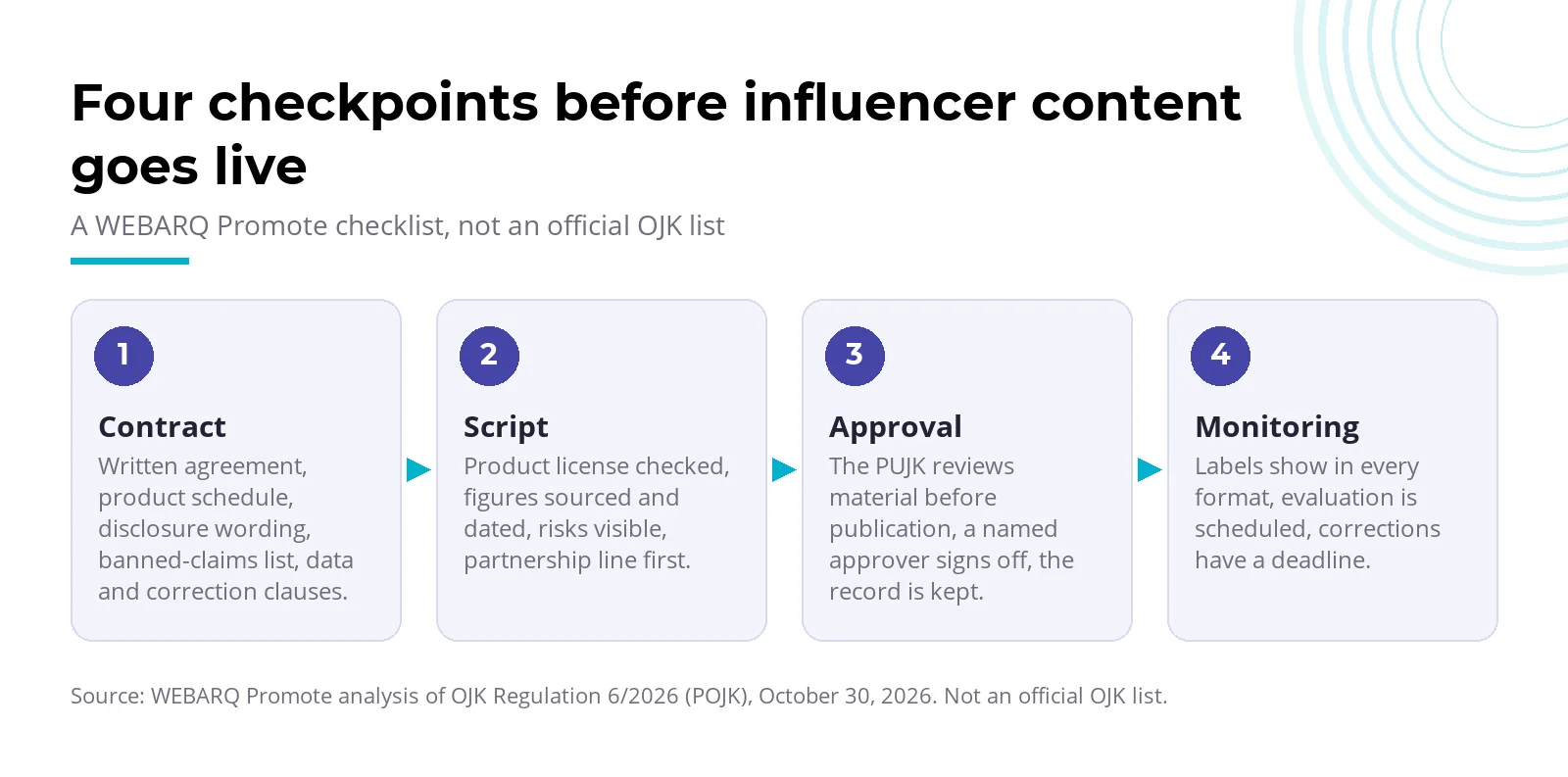
There are four checkpoints: contract, script, approval and monitoring. It's part of the same analysis, not an official OJK list.
- Contract. Written agreement, product schedule, disclosure wording, banned-claims list, data and correction clauses. Have legal review it.
- Script. Product license checked, figures sourced and dated, risks visible, partnership line first.
- Approval. The PUJK reviews material before publication, a named approver signs off, the record is kept.
- Monitoring. Labels show in every format, evaluation is scheduled, corrections have a deadline. Route leads into PUJK systems so lead quality can be measured.
What about AI-made content and crypto?
AI disclosure appears only in the elucidation to Article 2(c), as an example of clear and honest information: state that the content was made with AI and have a human verify it before publication. We still suggest writing it into contracts.
Influencers may market crypto-asset products to the public only through the PUJK's official media (Article 7(6)). Digital financial asset recommendations are limited to the exchange's list, and any PUJK recommended must be OJK-licensed (Article 8(5)).
By the text, certification doesn't apply to every recommender: Article 8(1)(c) ties it to digital financial asset recommendations where no license is required yet. As of October 26, 2026, Katadata reported that OJK's LSP list named no dedicated finfluencer certifiers. On October 22, AFTECH and IARFC Indonesia signed an MoU for a Verified Finfluencer program, but its certificate isn't a license to give personalized investment advice. We found no certification deadline.
Frequently asked questions
Do existing influencer contracts have to be revised?
Article 16 requires marketing partnerships that existed before June 4, 2026 to be brought into line, but the regulation does not prescribe contract clauses. We suggest an addendum covering the product list, disclosure wording, approval flow and content correction. Let your legal team decide the form, and audit older live content too.
Is the brand responsible for influencer content?
Yes, for marketing activity. Article 7(2)(g) makes the financial business responsible for the information the influencer delivers, and the OJK press release says the same. Influencers keep their own duties, such as stating their economic interest and not promising profit that doesn't fit the product.
What is the maximum fine under POJK 6/2026, and who can receive it?
The maximum administrative fine is Rp 15 billion under Article 7(9), for financial businesses that breach their Article 7(2) duties. The text names no fine amount for influencers. They face guidance, a Written Order and takedown, with criminal sanctions under the OJK Law if a Written Order is deliberately ignored.
Who is exempt from POJK 6/2026?
Article 14 exempts professions outside financial services acting within their legal duties under a code of ethics, such as educators in academic settings and journalists doing journalism. Information initiated by government or authorities, such as Bank Indonesia and LPS, is also exempt. Paid brand content shouldn't rely on this exemption.
Your first step this week: pull every active influencer and their live content, then check it against the matrix. Our Paid Social team can tidy that flow with your legal team.
This article is general information, not legal advice. Related reading: POJK 22/2023, screen by screen.