

Google Ads Expands Customer Retention Goals: What to Prepare Before the Holiday Peak



By Della · Updated October 25, 2026
On October 22, 2026, Google announced three updates to customer lifecycle goals in Google Ads: wider customer retention goals, New Customer High Value Mode for Shopping, and percentage bid multipliers. For teams used to tag-based remarketing, bidding that treats new customers, lapsed customers and loyalty members differently now reaches more campaign types, provided you hold the customer data yourself.
Re-engagement for Performance Max has actually been open to all advertisers since April 2025, per Google's Indonesian announcement. What's new this month is the push into Shopping and Search, Retention Only Mode and percentage multipliers. Google's October post says these are "rolling out this month": a staged rollout, unconfirmed for Indonesian accounts.
Key takeaways
- Re-engagement for Performance Max has been open to all advertisers since April 2025. The October 2026 additions are rolling out in stages and aren't confirmed for Indonesian accounts.
- As of October 25, 2026, Google's help pages still list Re-engagement for Performance Max only.
- Lapsed customers can only be identified through Customer Match lists. Tag-based remarketing lists aren't compatible.
- Harbolnas 2026 runs December 10–16. If your CRM data is thin, the next six weeks are better spent cleaning data than switching on a new mode.
What did Google announce, and what's still unclear?
High Value Mode now reaches Shopping, retention goals reach Search and Shopping, and percentage multipliers leave beta. What's unclear is timing per account, and why parts of the announcement aren't in the help center yet.
Customer lifecycle goals are Smart Bidding features that treat new, lapsed and existing customers differently, according to Google Ads Help. The announcement names three retention modes. Re-engagement prioritizes customers who haven't ordered in a while while still serving your main audience. Loyalty targets loyalty-program members, and Retention Only reaches just the customer segments you specify.
Percentage multipliers make a bid boost scale with cart size. Google's example: a 20% (1.2x) boost bids as aggressively for a USD 500 cart as for a USD 50 cart. In rupiah terms, the value bidding works with rises by about Rp 100,000 on a Rp 500,000 cart and Rp 1 million on a Rp 5 million cart. That's added conversion value, not an extra Rp 100,000 per click.
| Feature | Campaign types per the announcement | Per the help pages (Oct 25, 2026) |
|---|---|---|
| New Customer High Value Mode | Shopping, adding to Search and Performance Max | Performance Max and Search; Shopping not yet listed |
| Re-engagement Mode | Performance Max, Search, Shopping | Performance Max only; Shopping "soon" |
| Loyalty Mode | Performance Max, Search, Shopping | Performance Max and Shopping |
| Retention Only Mode | Named in the announcement | Not on any help page |
| Percentage multipliers | Search, Shopping, Performance Max, Demand Gen | Not found on help pages |
Who benefits, and who should wait?
The best-placed advertisers already track Purchase conversions with sensible values and refresh their Customer Match lists regularly. Lead-gen advertisers without purchase conversions, and brands that sell mostly through marketplaces, should wait.
The Re-engagement requirements on the customer retention help page are strict. You need a Performance Max campaign optimizing for the Purchase goal, New Customer Acquisition set to New Customer Value, and at least one Customer Match list of inactive customers. Without Google Ads purchase tracking, retention still works, but you have to upload and assign the inactive list manually.
Data is the real bottleneck. Google's guide to customer segment detection says lapsed customers are identified only through Customer Match: CRM or CDP connectors in Data Manager, the Google Ads API, or a direct upload. Tag-based lists don't qualify.
That hurts in Indonesia, where Tokopedia, Shopee or TikTok Shop buyers usually never reach the brand's own database. The Customer Match policy allows only first-party data collected directly through your site, app or store.
The same policy limits the Targeting setting to accounts with 90 days of history and over USD 50,000 in lifetime spend. It isn't tied to retention, but newer accounts should check.
What should you prepare before Harbolnas and year-end?
Prepare data, not new campaigns. Fortune Indonesia, quoting the Trade Minister, reports that Harbolnas 2026 runs December 10–16, with a transaction target 5–10% above 2025's Rp 36.4 trillion.
Changing goals and customer values mid-peak makes results hard to read: you can't separate the season from the new mode.
WEBARQ Promote readiness check. Method: Google's October 22, 2026 announcement compared with Google Ads help pages in Indonesian and English, checked October 25, 2026.
| Feature | Prerequisites | Data to upload | Most likely failure |
|---|---|---|---|
| New Customer High Value Mode | New Customer Value, value-based bidding, Purchase goal | Existing-customer list with a "high value" definition | Thin list or vague definition |
| Re-engagement | Performance Max, New Customer Value, Purchase goal | Customer Match list of inactive customers | List too small or stale |
| High Value Re-engagement | Same as Re-engagement | Inactive list plus high-value list | Unrealistic customer values |
| Loyalty Program Members | Value-based bidding | Member list plus loyalty benefits in the Merchant Center feed | Benefits missing from the feed |
| Retention Only Mode | Not documented | Segments you choose (per the announcement) | Don't set up until a help page exists |
| Percentage multipliers | Not documented | None | Inconsistent documentation |
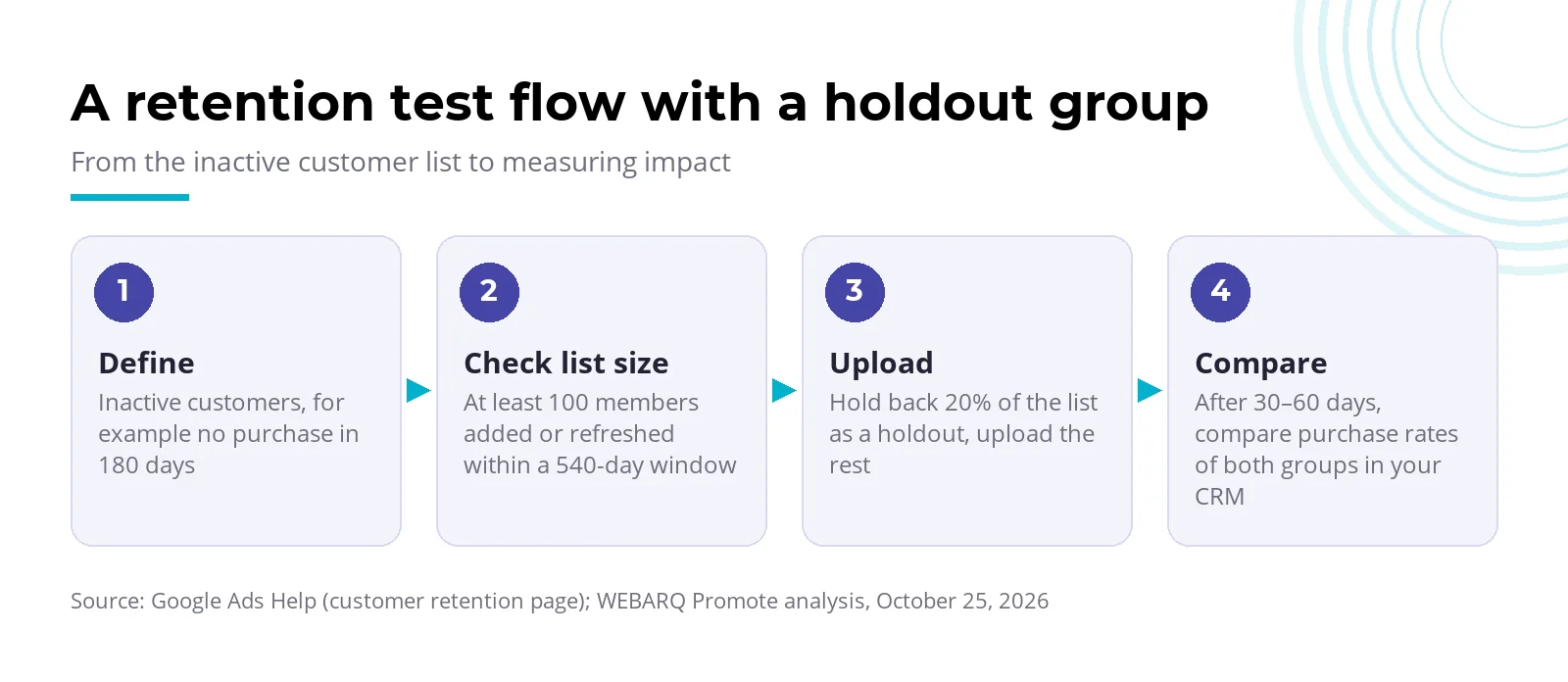
A sensible order of work for the next six weeks:
- Confirm the Purchase goal is active and sending correct transaction values.
- Define "inactive" (for example, no purchase in 180 days) and pull that list from your CRM.
- Check list size. To stay eligible, Google wants at least 100 members added or refreshed within a 540-day window.
- Set the inactive-customer value between your new-customer and existing-customer values, as Google recommends.
- Budget at least 20% more at the start, as Google suggests.
Step two involves personal data. The transition period of Indonesia's Personal Data Protection Law (Law 27/2022) ended on October 17, 2024. Article 20 requires a lawful basis for processing, and consent is only one of them. If you rely on consent, Article 21 requires telling people the purpose, data types and retention period, and Article 22(1) requires consent in written or recorded form. Settle the basis with counsel before you upload.
How do you know retention is adding anything?
Measure lapsed customers who came back because of the campaign, not every lapsed customer who bought. Some would buy during Harbolnas anyway.
Google's help page suggests tracking a re-engagement rate in your analytics: lapsed customers who returned, divided by total customers acquired from retention campaigns.
We'd add one step. Hold back part of the inactive list, say 20%, from the upload, then compare purchase rates for both groups in your CRM after 30–60 days. The gap is your incremental impact. Report new and returning customer revenue separately, so acquisition doesn't quietly shrink.
Decisions for this week's team meeting
- Clean CRM, tracked transactions, Performance Max already on New Customer Value: test Re-engagement on one campaign after Harbolnas, with a holdout group.
- Data exists but is scattered: use November to consolidate lists and check the lawful basis, then test in Q1 2027.
- Mostly marketplace sales, or a lead-gen model: leave it for now. Focus on conversion quality in the search engine marketing campaigns you already run.
Either way, ask your team or agency to show you the Customer retention menu in your account before promising management anything. An announcement isn't the same as a live feature.
Frequently asked questions
How is this different from Google Ads remarketing?
Classic Google Ads remarketing usually re-shows ads to people on a tag-based website list. Retention goals work on bidding instead, valuing lapsed or loyal customers differently. Lapsed customers can only be identified through Customer Match lists you upload, and tag-based remarketing lists are not compatible.
Are Google Ads retention goals available in Indonesia?
Partly. In an April 9, 2025 post on its Indonesian site, Google said retention goals for Performance Max were rolling out to all advertisers. What we can't confirm is the October 22, 2026 additions, such as retention in Search and Shopping, Retention Only Mode and percentage multipliers, because that announcement sits on Google's US site. Check for Customer retention in your own campaign settings.
Do retention goals replace new customer acquisition campaigns?
No. Google frames retention as a complement to new customer acquisition, and Re-engagement requires the campaign to use the New Customer Value setting. The retention help page also suggests raising budget at least 20% at the start, so the added focus doesn't crowd out acquisition.
Does uploading a customer list require consent under Indonesia's PDP Law?
Indonesia's PDP Law (Law 27/2022) requires a lawful basis for processing. Explicit consent is one basis; others include contract and legitimate interests. Google's Customer Match policy also asks for consent where law or Google policy requires it. Which basis applies to your list is a legal judgment, so check with counsel before uploading.
If you'd like to map your data readiness and campaign structure before testing retention goals, the WEBARQ Promote Paid Search team can audit it with you. For the wider measurement picture, see our explainer on performance marketing.
This article is general information, not legal advice.