

Google Ads Smart Bidding for Lead Generation: When to Use Maximize Conversions, Target CPA or Target ROAS


By Bagas · Updated November 15, 2026
For lead generation accounts where a form fill turns into a sale weeks later, the choice of Google Ads Smart Bidding strategy is rarely the real problem. The signal is. The bidder chases whatever sits in the Conversions column, so if every form fill counts, it will find you form fills, including people who never answer the sales team's WhatsApp.
For most accounts, the safe order is Maximize conversions first, Target CPA once you know the CPA you can accept, and Target ROAS only after leads carry values from your CRM.
Key takeaways
- As of November 2026, Google Ads has four Smart Bidding strategies: Maximize conversions, Target CPA, Maximize conversion value and Target ROAS.
- Target ROAS on Search requires 15 conversions in 30 days and at least two different conversion values. To judge results, Google uses 30 conversions over a month (50 for Target ROAS).
- If leads take more than seven days to become sales, make an earlier stage such as a qualified lead the primary conversion and import it from your CRM daily.
- Budget and target changes don't trigger Learning. New strategies, campaign composition changes and conversion goal changes do.
What is Smart Bidding, and which strategies actually exist as of November 2026?
Smart Bidding is the set of Google Ads bid strategies that use Google AI to win conversions or conversion value auction by auction. Google's Smart Bidding page lists four, and none works without conversion tracking.
Since June 2026, "Maximize conversions with a Target CPA" is labeled Target CPA, and "Maximize conversion value with a Target ROAS" is labeled Target ROAS. Google says behavior is unchanged and no action is needed, though old and new labels may coexist during the rollout.
| Strategy (November 2026 name) | What it goes after | Needs conversion values? | Target you set |
|---|---|---|---|
| Maximize conversions | Most conversions, spending the daily budget | No | None |
| Target CPA | Most conversions at your average CPA | No | Average CPA |
| Maximize conversion value | Most value, spending the daily budget | Yes, at least two different values | None |
| Target ROAS | Most value at your average ROAS | Yes; on Search also 15 conversions in 30 days | Average ROAS |
Maximize conversions isn't a second-class option. It's built to spend the budget, and Google's Maximize conversions page tells you to check the budget first: if a campaign has been spending well below it, spend can rise sharply.
How many conversions do you need before moving off Manual CPC or Maximize conversions?
No single minimum applies. Per Google Ads documentation as of November 2026, Target CPA can start with no conversion history and Maximize conversions states no minimum, while Target ROAS on Search requires 15 conversions in 30 days. The often-quoted 30 conversions is Google's bar for judging results, not for starting.
Volume: the bar to start differs from the bar to judge
To evaluate results, Google recommends a month or more with at least 30 conversions, and 50 for Target ROAS. On Google's Target CPA page, the recommended target is your average CPA over the last 30 days, adjusted for conversion delay.
Ten leads a month across eight campaigns won't get far. Google notes that fewer, larger campaigns generally perform better, so consolidate before you change strategy.
Conversion lag: how fast clicks become real leads
A conversion cycle is how long a click usually needs to turn into a conversion. Google's guide to adjusting targets says to wait one to two cycles after a target change before judging it.
Google's page on value-based bidding for Search and Shopping recommends conversion delays under seven days. If nothing is uploaded within seven days of the click, the initial ramp-up of value-based bidding can take several months. For property, vehicles or B2B deals with a two-month close, "deal won" is too slow to be a bidding signal.
When should you use Maximize conversions, Target CPA or Target ROAS for lead generation?
Choose on three things: conversion volume, how long leads take to become sales, and whether lead values differ. If every lead counts the same, pick Maximize conversions or Target CPA; Target ROAS needs at least two different values.
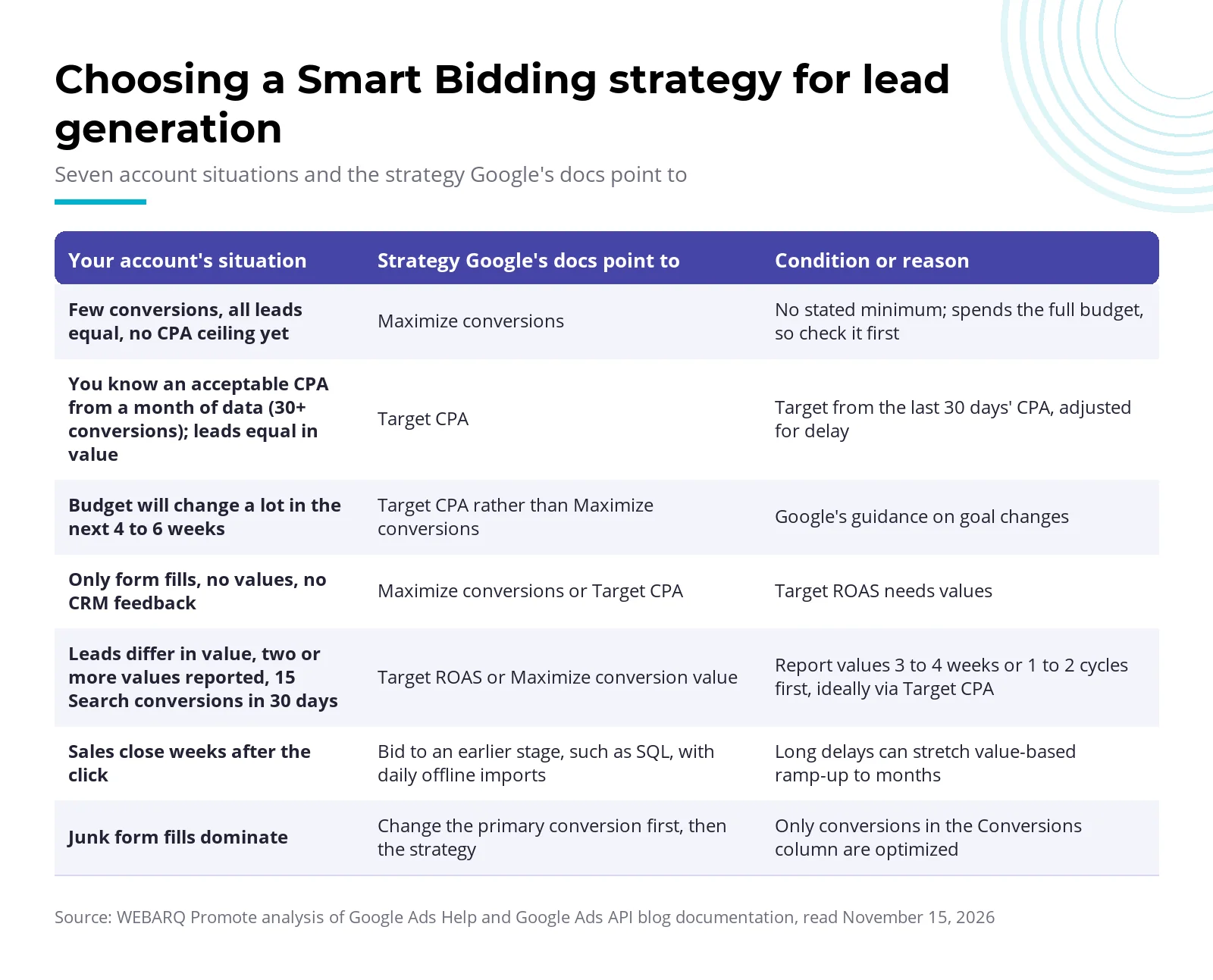
The table below is this article's original element. Method: a WEBARQ Promote analysis of 21 Google documentation pages (Google Ads Help and the Google Ads API blog) read on November 15, 2026, with no third-party benchmarks and no made-up CPA figures.
| Your account's situation | Strategy Google's docs point to | Condition or reason |
|---|---|---|
| Few conversions, all leads equal, no CPA ceiling yet | Maximize conversions | No stated minimum; spends the full budget, so check it first |
| You know an acceptable CPA from a month of data (30+ conversions); leads equal in value | Target CPA | Target from the last 30 days' CPA, adjusted for delay |
| Budget will change a lot in the next 4 to 6 weeks | Target CPA rather than Maximize conversions | Google's guidance on goal changes |
| Only form fills, no values, no CRM feedback | Maximize conversions or Target CPA | Target ROAS needs values |
| Leads differ in value, two or more values reported, 15 Search conversions in 30 days | Target ROAS or Maximize conversion value | Report values 3 to 4 weeks or 1 to 2 cycles first, ideally via Target CPA |
| Sales close weeks after the click | Bid to an earlier stage, such as SQL, with daily offline imports | Long delays can stretch value-based ramp-up to months |
| Junk form fills dominate | Change the primary conversion first, then the strategy | Only conversions in the Conversions column are optimized |
Row three comes from Google's guide to changing conversion goals. For the move to a new strategy or goal, it points to Maximize conversions when no large budget changes are planned for the next 4 to 6 weeks, and to Target CPA when they are.
On row five, two Google pages disagree. Google's Target ROAS page says four weeks or one to two conversion cycles, whichever is longer; the value-based bidding page says three weeks. We use the longer one.
How do you get Google to chase qualified leads instead of form fills?
Change what counts as the primary conversion, then send sales-stage data from your CRM back to Google Ads. While form fills are the primary action in the Conversions column, the system can't tell a serious lead from a casual one.
Demote form fills to secondary once a qualified-lead action is flowing; our lead generation landing page checklist covers form fields that filter leads.
Offline conversion import and enhanced conversions for leads
Offline conversion import relies on the Google Click ID (GCLID), a unique ID for every ad click. As Google's offline conversion import page explains, you store the GCLID with the lead and send it back with the conversion type and time when that lead, say, signs a contract.
Enhanced conversions for leads adds hashed emails and phone numbers alongside the GCLID. Google claims this gave advertisers a median 10% lift in conversions over standard offline import, without giving a sample, period or country. For the server side, see our server-side tracking and Conversions API guide.
For developers: per the Google Ads API team's May 15, 2026 announcement, since June 15, 2026 new adopters can't start offline conversion import through the Google Ads API. Existing integrations can keep importing through the Google Ads API while they move to the Data Manager API, which is now Google's main route.
Customer emails and phone numbers are personal data. In Indonesia, get consent in line with the Personal Data Protection Law (UU PDP) and send only the fields needed for matching. This is general information, not legal advice.
Putting a value on each lead stage
Google asks you to pick one stage in the lead-to-sale journey as the bidding goal, using real revenue or a proxy such as a lead score. Our suggested logic (a WEBARQ Promote method, not a Google formula): stage value = share of leads at that stage that eventually close × average deal value.
The example below is a worked illustration, not campaign data. Use your own CRM history.
| CRM stage | Assumed close rate | Stage value (average deal Rp 40,000,000) |
|---|---|---|
| Form fill | 2% | Rp 800,000 |
| MQL | 10% | Rp 4,000,000 |
| SQL | 30% | Rp 12,000,000 |
| Closed | 100% | Rp 40,000,000 |
If SQL is the bidding stage and Rp 36,000,000 of spend yields 5 SQLs, conversion value is 5 × Rp 12,000,000 = Rp 60,000,000. ROAS is Rp 60,000,000 / Rp 36,000,000 = 167%, the format Google uses for targets.
But one fixed value for one stage is one value, and value-based bidding needs two. Unless SQL values differ, by product line for instance, Target CPA on the SQL stage is the more honest choice. That matches Google's own example: Qualified Leads on Target CPA first, values next, then the switch. Don't backfill historical values.
Checklist for the learning period and budget changes
Learning is a status that flags a recent structural change. Per Google's page on Smart Bidding learning, it never lasts more than seven days and ads keep serving.
What triggers Learning
Three things: a new strategy (created or reactivated), a composition change (campaigns, ad groups or keywords added to or removed from the strategy), and a significant change to conversion goals or actions. Budget, target, creative, location and audience changes don't.
How to change targets without wrecking your data
Change one target, then wait one to two conversion cycles. Raising a CPA target or lowering a ROAS target increases spend; moving the other way favors efficiency. Ignore the last few days, whose conversions haven't arrived.
Since August 17, 2026, Google has changed how budget-limited Target CPA and Target ROAS campaigns bid across Travel, Demand Gen, Performance Max, Shopping and Search. They now deliver more consistently toward the stated target, and campaigns that used to beat it may move toward it. Google doesn't adjust targets or budgets for you, so recheck yours.
The 2x daily budget rule
According to Google's page on overdelivery, any campaign may spend up to twice its average daily budget on a given day, with a monthly cap of 30.4 times that budget. So a Rp 2,000,000 daily budget can spend Rp 4,000,000 in one day (worked illustration, not campaign data).
Before you touch anything:
- Check the budget is money you're ready to spend, with one primary goal.
- Batch structural changes so Learning happens once.
- Change targets one at a time, one to two conversion cycles apart.
- For Maximize conversions, use the budget simulator, not the Lost IS (budget) column.
Example: an A/B test of Maximize conversions vs Target CPA
In a Google Ads search campaign for MISUMI, a maker and distributor of standard engineering components, the WEBARQ Promote team ran an A/B test of two bid strategies, maximizing conversions and targeting a cost per acquisition (CPA), to see which was more efficient.
Published results for the whole campaign: approximately 141,000 clicks, a CTR of over 20% and a conversion rate of around 10%. The case study doesn't say which strategy won, so don't read those figures as one strategy's result. What carries over is the method: test side by side, not this month against last month.
Mistakes that waste the most budget
Each of these four mistakes runs against the Google guidance covered above, and each can be fixed without switching bid strategy.
- Counting every form fill, WhatsApp click and phone call as a primary conversion.
- Setting Target CPA too low. Google warns this can cost you clicks and reduce total conversions.
- Changing targets every two days, before one conversion cycle has passed.
- Uploading CRM data once a month, when Google recommends daily uploads.
For existing customers, see our breakdown of Google Ads customer retention goals.
Frequently asked questions
What is Smart Bidding in Google Ads?
In Google Ads, Smart Bidding means the bid strategies that use Google AI to win conversions or conversion value auction by auction. As of November 2026 there are four: Maximize conversions, Target CPA, Maximize conversion value and Target ROAS. All need conversion tracking.
Is Target CPA or Target ROAS better for lead generation?
For most lead generation accounts, Target CPA. Target ROAS needs at least two different conversion values, and form fills carry none until CRM data comes back. Google advises moving to qualified leads on Target CPA first, passing values, then switching.
How many conversions does Smart Bidding need?
There's no single number. Per Google Ads documentation as of November 2026, Target CPA can start with no history and Maximize conversions states no minimum. Target ROAS on Search requires 15 conversions in 30 days. To judge results, Google suggests a month or more with 30 conversions, or 50 for Target ROAS.
How long is the Smart Bidding learning period?
The Learning status never lasts more than seven days, and ads keep serving. A new strategy, a change in the campaigns or keywords it covers, or a conversion goal change triggers it. Performance usually settles after one to two conversion cycles, Google says.
Do I still need Manual CPC?
Manual CPC is still available and makes sense while an account lacks conversion tracking you can trust, since every Smart Bidding strategy depends on it. Once your main conversion is recorded correctly, Maximize conversions can start without a target, so treat Manual CPC as a temporary stage.
Want to know whether your account's conversion signal is strong enough for Target CPA or Target ROAS? The WEBARQ Promote Paid Search team can audit your conversion goals, offline imports and bid strategy before any target changes.