
Google AI Overviews and AI Mode: What 30 Indonesian Business Queries Show and What to Change in SEO



By Angelica · Updated October 26, 2026
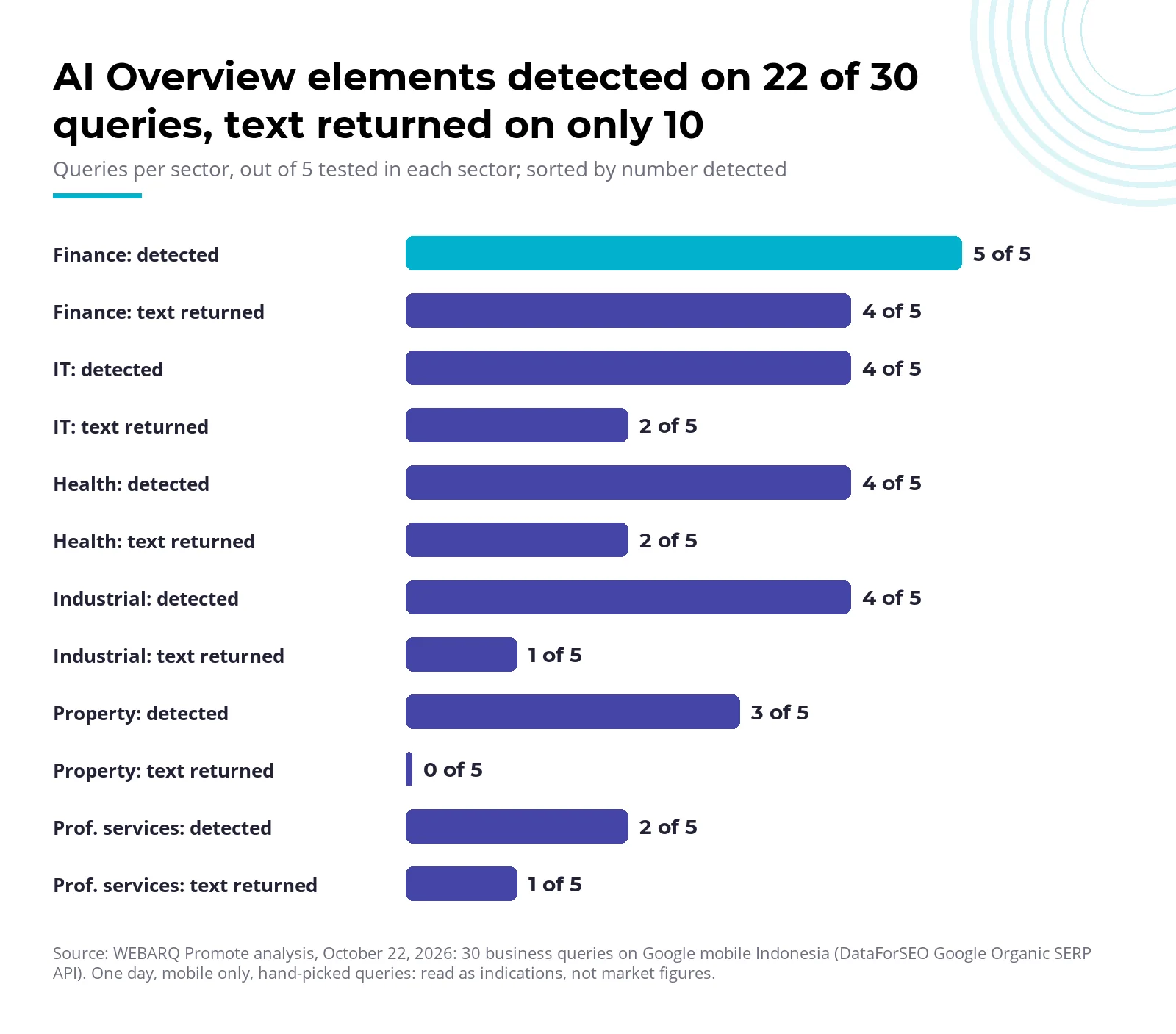
The WEBARQ Promote team ran 30 Indonesian-language business queries on Google mobile on October 22, 2026, and detected an AI Overview element on 22 results pages, but only 10 returned its text and sources. In those 10 answers, just 12 of 75 cited web pages (16%) also appeared in the same query's organic results.
The next layer, AI Mode (Mode AI), has been live in Indonesian since September 2025 and now takes follow-up questions from AI Overviews (Ringkasan AI). For a CMO setting the 2027 budget, the fallout lands in reporting: read impressions, clicks, and leads separately.
Key takeaways
- Our Google mobile test (October 22, 2026) detected an AI Overview element on 22 of 30 business queries (73%), but text came back for only 10 (33%). Price queries: 8 of 8 detected.
- In the 10 readable AI Overviews, 73% of 81 cited links went to company-owned pages; none went to government, university, or Wikipedia pages.
- Click-impact evidence so far comes from the US: Pew Research Center (2025) found regular results clicked on 8% of visits to pages with an AI summary, versus 15% without.
- For 2027, track your 30 revenue-driving queries, report impressions, clicks, and leads separately, and skip llms.txt or special schema, which Google says you don't need.
How do AI Overviews and AI Mode differ, and are they live in Indonesia?
An AI Overview is an AI-written summary that appears automatically above Google's results, with links to supporting pages. AI Mode is Google's conversational search mode for complex questions. Both work in Indonesian: Google Indonesia announced AI Overviews on September 5, 2024, and launched AI Mode on September 9, 2025.
| Aspect | AI Overviews (Ringkasan AI) | AI Mode (Mode AI) |
|---|---|---|
| Format | Summary block with supporting links | Conversation with follow-up questions; text, voice, or image input |
| When it shows | Automatically, only when Google's systems judge a summary adds value | When the user opens it or asks a follow-up; most useful for exploration and complex comparisons |
| Search Console counting | All links inside share one position | A follow-up question counts as a new query |
Sources: Google Search Central (updated December 10, 2025) and Search Console Help.
As of October 2026, Google's help page lists Indonesia and Indonesian as supported. AI Overviews can't be turned off; the Web filter, showing text links only, is the one alternative Google offers. On mobile, the "Tanyakan apa saja" (ask anything) box, reached via "Tampilkan lebih banyak" (show more), moves the conversation to AI Mode. Reports that links inside AI Overviews now open AI Mode trace to a test seen by one SEO practitioner; Google hasn't confirmed it. Our generative engine optimization explainer covers the underlying idea.
How much do AI Overviews cut clicks to websites?
Clicks to websites drop on queries that trigger an AI summary; the available studies, mostly from the US, agree. Pew Research Center found a regular result was clicked on 8% of visits to results pages with an AI summary, versus 15% without (March 2025 data). No comparable public study exists for Indonesia.
| Source | Sample and period | Finding | Evidence type |
|---|---|---|---|
| Field experiment, Indian School of Business researchers (July 2026) | 1,000+ US participants, two weeks | With an AI Overview, outbound organic clicks fell 39.8% and zero-click searches rose 34.5% | Causal (randomized), seminar paper |
| Pew Research Center (July 2025) | 900 US adults, 68,879 searches, March 2025 | Regular result clicked on 8% vs. 15% of visits; link inside the summary on 1% | Panel data |
| Seer Interactive (April 2026) | 53 brands, 5.47 million queries, January 2025–February 2026 | Organic CTR on AI Overview queries: about 3.2% (January 2025), 1.31% (December 2025), 2.36% (February 2026) | Correlation |
| Ahrefs (February 2026) | 300,000 keywords, December 2023 vs. December 2025 | Position-1 CTR about 58% lower on AI Overview keywords | Correlation |
| Google (August 2025) | No public data | Total organic clicks "relatively stable"; click quality said to be higher | Platform claim |
The four studies agree on direction, not size: each measures something different. Seer and Ahrefs also don't name their data's country, so don't add these numbers up or treat them as Indonesian benchmarks.
One Seer finding belongs in your strategy: on informational queries, brands cited in an AI Overview earned about 120% more clicks per impression than uncited brands, though still about 38% fewer than on queries with no AI Overview. Google's higher-quality-click claim has no public data behind it, and the randomized experiment found no engagement difference after the click.
How often do AI Overviews appear on Indonesian business queries?
Our test detected an AI Overview element on 22 of 30 business queries (73%), with text returned for only 10 (33%). Price queries triggered it most, provider and local queries least. It's a one-day snapshot of Google mobile, not a market figure.
Method
WEBARQ Promote analysis, October 22, 2026. We sent 30 fixed queries to the DataForSEO Google Organic SERP API (live, advanced): one call per query, location Indonesia, language Indonesian, mobile, depth 10, all on one day, all successful (status code 20000). Each of six sectors got five queries, grouped by wording into evaluative ("terbaik" = best, "cara memilih" = how to choose, "vs"; 10), price ("harga" = price, "bunga" = interest; 8), and provider or local ("jasa" = service, "sewa" = rent, "supplier", "leasing", city names; 12).
We logged the AI Overview element, its links, any featured snippet, and the 8–10 organic results per page. On 12 pages, the tool received only an empty container that Google fills in later (asynchronously). Hence two measures: element detected (22 of 30; 95% Wilson interval 56%–86%) and text and sources returned (10 of 30; 19%–51%). What the 12 containers hold is unknown, and not every one necessarily shows an answer, so 10 is a floor for what users see.
Limits: one day, one data provider, mobile only, no specific city, and 30 hand-picked queries, not a random sample. The test measures presence and citations, not clicks or traffic, and can't reach AI Mode.
Results by sector and query type
With five queries per sector, read these numbers as indications.
| Sector | Queries tested (in Indonesian) | Detected | Text returned |
|---|---|---|---|
| IT | software erp terbaik, harga software erp, jasa pembuatan aplikasi mobile, cara memilih software house, cloud server indonesia | 4/5 | 2/5 |
| Professional services | digital marketing agency terbaik, harga jasa seo, jasa google ads, cara memilih jasa seo, jasa konsultan pajak jakarta | 2/5 | 1/5 |
| Industrial | supplier bahan kimia industri, harga mesin cnc, jasa freight forwarding terbaik, forklift listrik vs diesel, sewa forklift jakarta | 4/5 | 1/5 |
| Finance | asuransi kesehatan karyawan terbaik, bunga kredit modal kerja, leasing alat berat, kpr bank terbaik, bunga deposito tertinggi | 5/5 | 4/5 |
| Property | sewa kantor jakarta, harga interior kantor per meter, jasa kontraktor interior kantor, apartemen jakarta selatan dijual, cara memilih developer properti | 3/5 | 0/5 |
| Health | medical check up perusahaan, harga general check up, rumah sakit jantung terbaik jakarta, supplier alat kesehatan, harga operasi katarak | 4/5 | 2/5 |
By query type the pattern is sharper: price 8 of 8 detected (6 with text), evaluative 9 of 10 (2), provider or local 5 of 12 (2). All eight pages without an AI Overview element showed a local pack (the map block), which appeared on 8 of 12 provider or local queries and no price query. That's co-occurrence, not proof that local packs keep AI Overviews away. Not one featured snippet appeared among the SERP features we logged.
Who gets cited, and do you need a top-10 ranking?
Mostly company pages, and not necessarily top-10 ones. Of the 81 links in the 10 readable AI Overviews (8.1 per answer), 59 (73%) went to company sites such as banks, hospitals, software vendors, and service providers: 35 guides or articles, 24 product, service, or pricing pages. The rest: marketplaces and portals (9), social and video platforms (5), Google Shopping cards (5), news outlets (2), and one unresolved Google redirect. No government, university, Wikipedia, or platform documentation pages were cited.
Only 12 of the 75 cited web pages (16%) also appeared in the same page's organic results, all in finance answers (12 of 35; other sectors 0 of 40), at organic ranks 1–9. At the domain level, counted per answer, it's 21 of 69 (30%). That fits Google's documentation on query fan-out. Query fan-out is a technique where the system runs many subtopic searches at once and merges the results; Google says both features can use it, yielding more varied links than one classic search.
No domain dominates: 58 of 63 cited web domains (92%) appear in only one answer. Instagram is the most frequent (3 of 10 answers), followed by a national bank's site, a private bank's site, a health information portal, and an ERP software vendor's site, two answers each.
What it means for your category
- Price or interest-rate queries: plan as if an AI Overview is always there. State price ranges and their drivers in text, and keep Merchant Center current; for "harga mesin cnc" (CNC machine price), 5 of 8 links were Google Shopping cards.
- "Jasa" (service) or "sewa" (rent) plus a city: local packs appeared more often, so update your Google Business Profile first.
- Evaluative queries: for "software erp terbaik" (best ERP software), 8 of 9 cited pages were guides or articles on vendors' own sites. Without a comparison guide of your own, your odds of being cited on queries like this are slim.
What should change in your B2B SEO?
Change four things: the queries you track, how your pages answer, your product and location data, and how you report. The technical bar stays put: per Search Central, a page must be indexed, snippet-eligible, and meet Google Search's technical requirements to be a source.
| Change | Why | Metrics | Owner |
|---|---|---|---|
| Track your 30 revenue-driving queries monthly | AI Overview presence varies sharply by query type | Share of queries with an AI Overview; share citing your domain | SEO lead |
| Write direct answers, numbers, and sources as text on pricing, product, and comparison pages | 73% of links in our test went to company pages | Citations per month; organic CTR of those pages | Content lead |
| Keep Merchant Center and Google Business Profile current | Both are on Google's fundamentals list for AI features | Data completeness; clicks from listings | E-commerce or branch marketing |
| Report impressions, clicks, and leads separately | An AI Overview is one position; an AI Mode follow-up is a new query | Impressions in the generative AI performance report, clicks, leads, CRM pipeline | Head of Digital |
On writing, the academic reference is the GEO study (Aggarwal et al., KDD 2024). In a research engine built on gpt-3.5-turbo, adding citations, quotations, and statistics raised a source's visibility score by roughly 30–40% in relative terms; keyword stuffing did little or nothing.
Two caveats. The effect depends on rank: in a test where every source was optimized at once, citing sources raised fifth-ranked sites' visibility 115.1%, while first-ranked sites lost 30.3% on average. And AI Overviews, AI Mode, and classic rankings weren't tested, so treat this as a hypothesis, not a promise.
What doesn't need to change?
Getting into AI Overviews or AI Mode doesn't require llms.txt, AI-specific files, or special schema. Google's documentation is blunt: "You don't need to create new machine readable files, AI text files, or markup to appear in these features." Structured data still helps if it matches the visible text.
The fundamentals are your technical SEO checklist: robots.txt and the CDN don't block crawling, internal links make content findable, key content is in text, and the site is verified in Search Console. Google-Extended is not an AI Overviews opt-out; Search crawling still follows robots.txt rules for Googlebot. To limit what's shown, use nosnippet, data-nosnippet, max-snippet, or noindex, and allow days to months for changes to apply.
These fundamentals drive organic traffic. The results published in our Indonet case study are "404%: Growth in organic traffic" and "78%: Percentage of reaching Google's first page in 6 months", both organic results, not AI visibility. Nobody can guarantee AI citations. If your team is stretched, our SEO services team can run this audit with you.
What should you tell the board about the 2027 budget?
Tell them three things: how many revenue-driving queries trigger an AI Overview, how much click value is at risk, and which metrics you'll report from the first quarter. Avoid both extremes, "SEO is dead" and "nothing has changed." The evidence supports neither.
The risk formula: monthly impressions on AI Overview queries × expected CTR drop × lead conversion rate × average lead value. With hypothetical numbers, 10,000 impressions, CTR falling from 3% to 2%, 3% conversion, and a Rp 10 million lead value mean 100 clicks, 3 leads, and Rp 30 million of pipeline at risk each month. Use your own Search Console and CRM data, not US study percentages.
First steps this month
- List the 30 queries closest to revenue and log each one's AI Overview status: detected, with text, and whether your domain is cited.
- Pick two or three changes from the table above, each with an owner and a deadline.
- Move part of the content budget to pricing pages, comparison pages, and evergreen content whose data you refresh quarterly.
Frequently asked questions
Are AI Overviews available in Indonesia?
Yes. Google Indonesia announced AI Overviews on September 5, 2024, with a staged rollout, and the Indonesian interface calls them Ringkasan AI. They can't be turned off, though the Web filter shows text links only. AI Mode (Mode AI) has been available in Indonesian since September 9, 2025.
Do AI Overviews reduce traffic to websites?
On queries that trigger them, yes. The strongest evidence, a randomized US test with more than 1,000 users, found outbound organic clicks fell 39.8% (seminar paper, July 2026). Google calls total clicks relatively stable but has published no data. No Indonesian study exists, so measure it in Search Console and your lead data.
What's the difference between AI Overviews and AI Mode?
An AI Overview is a summary block that appears automatically above search results when Google judges it useful. AI Mode is a conversational search users open for complex questions, using text, voice, or images. Follow-ups under an AI Overview continue in AI Mode, and Search Console counts each as a new query.
How can my site get cited in AI Overviews?
There's no guaranteed way. Google lists three requirements: indexed, snippet-eligible, and meeting Google Search's technical requirements, with no special files or schema. In our test, 73% of links in the 10 readable AI Overviews went to company pages, and only 16% of cited pages also appeared in that query's organic results.
How do I measure AI Overviews in Search Console?
AI Overviews and AI Mode appearances already count in Search Console's Performance report (Web search type), and all links in one AI Overview share one position. The generative AI performance report, rolling out to a subset of sites since June 3, 2026, shows impressions only; clicks and leads come from Performance, Analytics, and your CRM.
Want to know how your brand shows up in AI answers? Our AI Search Optimization team can map where you stand.