
AI Visibility Audit: How to Check Whether ChatGPT, Gemini and Perplexity Name Your Brand



By Angelica · Updated November 11, 2026
Brand visibility in AI answers isn't measured by rank. An AI visibility audit asks four questions instead: does the engine name your brand, where does it place you among the brands it names, in what tone, and which source does it draw on. You can answer all four without buying a tool first.
Our demo run on November 11, 2026 showed where this kind of measurement stops: the tool detected an AI Overview element in every successful reply but couldn't read a single one. One ChatGPT screenshot isn't evidence for a board meeting.
Key takeaways
- An AI visibility audit scores four things per prompt and per engine: mentioned or not, position among named brands, sentiment, and the type of source cited.
- The 30 prompts split into 8 awareness, 10 consideration, 8 decision and 4 reputation prompts, with [category], [brand] and [city] slots for reuse in any industry.
- WEBARQ Promote's proposed sheet weights mention at 40, position 25, sentiment 15 and source 20. These weights are our convention, not an industry standard.
- In our November 11, 2026 test, Google's organic results changed for 4 of 5 queries repeated within minutes. Run every prompt at least three times before you conclude anything.
What does an AI visibility audit actually measure?
An AI visibility audit is a structured test that records how often and how a brand appears in AI-generated answers to the questions buyers ask. There's no position 1 to 10 here, because an AI answer has no fixed ranked list.
The paper GEO: Generative Engine Optimization (Aggarwal et al., KDD 2024) hit the same problem and built its own "impression" metrics: the share of an answer's words that cite a source, weighted by how early the citing sentence appears. Our sheet's "position in the answer" idea follows that logic, but its weights don't come from the paper.
For a CMO or a communications team, four metrics are enough:
| Metric | Question it answers | How to record it |
|---|---|---|
| Mention (M) | Does your brand appear in the answer? | 0 or 1 |
| Position (P) | Where are you among the brands named? | 1, 2-3, or 4+ |
| Sentiment (S) | How does the AI describe your brand? | Positive, neutral, negative, plus the quoted phrase |
| Source (C) | Where did the AI get its information? | Own site, media, marketplace/review, forum, or none |
Some things it can't prove. AI answers aren't deterministic, so one round is only a sample, and the audit measures neither clicks nor sales. Google's own AI Overviews help page warns that AI answers can be wrong and suggests trying several versions of a question.
The APJII 2026 survey counted 235,261,078 internet users in Indonesia, a penetration of 81.72% (detikInet, May 22, 2026), yet only 18.2% of respondents said they use AI services (Metro TV News). That's why an Indonesian audit should always include Google Search alongside ChatGPT, Gemini and Perplexity.
How do you build a 30-prompt set by funnel stage?
Start from questions real buyers ask, then split them by stage: 8 awareness, 10 consideration, 8 decision and 4 reputation. Slots let you reuse the set for another category. The right-hand column shows the Indonesian queries we ran in the demo for online accounting software for small businesses (UKM). A2, A4, C8, C10 and D8 weren't run, and D2 and R1 failed; the results section has the details.
| ID | Stage | Template prompt | Demo query (Indonesian) |
|---|---|---|---|
| A1 | Awareness | What is [category]? | apa itu software akuntansi online |
| A2 | Awareness | Does a business like [segment] need [category]? | apakah UKM perlu software akuntansi |
| A3 | Awareness | What are the benefits of [category] for [segment]? | manfaat software akuntansi untuk UKM |
| A4 | Awareness | How do I [core task] for [segment]? | cara membuat laporan keuangan UKM |
| A5 | Awareness | What's the difference between [category] and [old way]? | perbedaan software akuntansi online dan excel |
| A6 | Awareness | [category] for [segment] | software akuntansi online untuk UKM |
| A7 | Awareness | [cloud/app version of category] for [size] | aplikasi akuntansi cloud untuk bisnis kecil |
| A8 | Awareness | Problems with [manual process] in [segment] | masalah pembukuan manual UKM |
| C1 | Consideration | Best [category] for [segment] | software akuntansi online terbaik untuk UKM |
| C2 | Consideration | Recommended [category] for [segment] | rekomendasi aplikasi akuntansi untuk UKM |
| C3 | Consideration | Free [category] for [segment] | aplikasi akuntansi gratis untuk UKM |
| C4 | Consideration | [category] comparison for [segment] | perbandingan software akuntansi online UKM |
| C5 | Consideration | [category] with [need 1] | software akuntansi dengan fitur pajak dan e-faktur |
| C6 | Consideration | [category] integrated with [other system] | software akuntansi terintegrasi marketplace |
| C7 | Consideration | [category] for [business model] in [city] | aplikasi akuntansi untuk toko online |
| C8 | Consideration | [category] that's easy for beginners | software akuntansi mudah dipakai pemula |
| C9 | Consideration | [category] with [need 2] | software akuntansi dengan stok inventori UKM |
| C10 | Consideration | [category] on mobile | aplikasi akuntansi di HP untuk UKM |
| D1 | Decision | [category] pricing for [segment] in [city] | harga software akuntansi online untuk UKM |
| D2 | Decision | Monthly [category] subscription plans | paket langganan software akuntansi UKM per bulan |
| D3 | Decision | Best [category] [year] | software akuntansi online terbaik 2026 |
| D4 | Decision | How to choose [category] for [segment] | cara memilih software akuntansi untuk UKM |
| D5 | Decision | Is [category] safe? | apakah software akuntansi online aman |
| D6 | Decision | How to move from [old way] to [category] | cara pindah dari excel ke software akuntansi |
| D7 | Decision | [category] free trial | software akuntansi uji coba gratis |
| D8 | Decision | Online vs desktop [category] for [segment] | software akuntansi online vs desktop untuk UKM |
| R1 | Reputation | What do people say about [brand]? | review software akuntansi online UKM |
| R2 | Reputation | Is [brand] trustworthy? | software akuntansi online terpercaya |
| R3 | Reputation | Pros and cons of [brand] | kelebihan dan kekurangan software akuntansi online |
| R4 | Reputation | User complaints about [brand] | keluhan pengguna software akuntansi UKM |
Awareness: does your brand help define the category?
Prompts A1 to A8 don't ask for brands, so look at the source: is the engine explaining the category with your page or someone else's?
Consideration: who makes the shortlist?
Consideration prompts decide most of the score, because this is where the AI builds and orders a list of brands. Fill the [need] slots with features that set your product apart, such as e-invoicing (e-faktur).
Decision: does the AI get prices and terms right?
On pricing, security and migration prompts, log every wrong figure or condition with its cited source. For a bank or multifinance company, an outdated interest rate or application requirement should go straight to compliance.
Reputation: what does the AI say about your company?
Reputation prompts matter most to listed (Tbk) companies and the corporate secretary's office. Run the brand versions. In the demo we used category-level versions, since it didn't audit any one brand.
How do you build the scoring sheet?
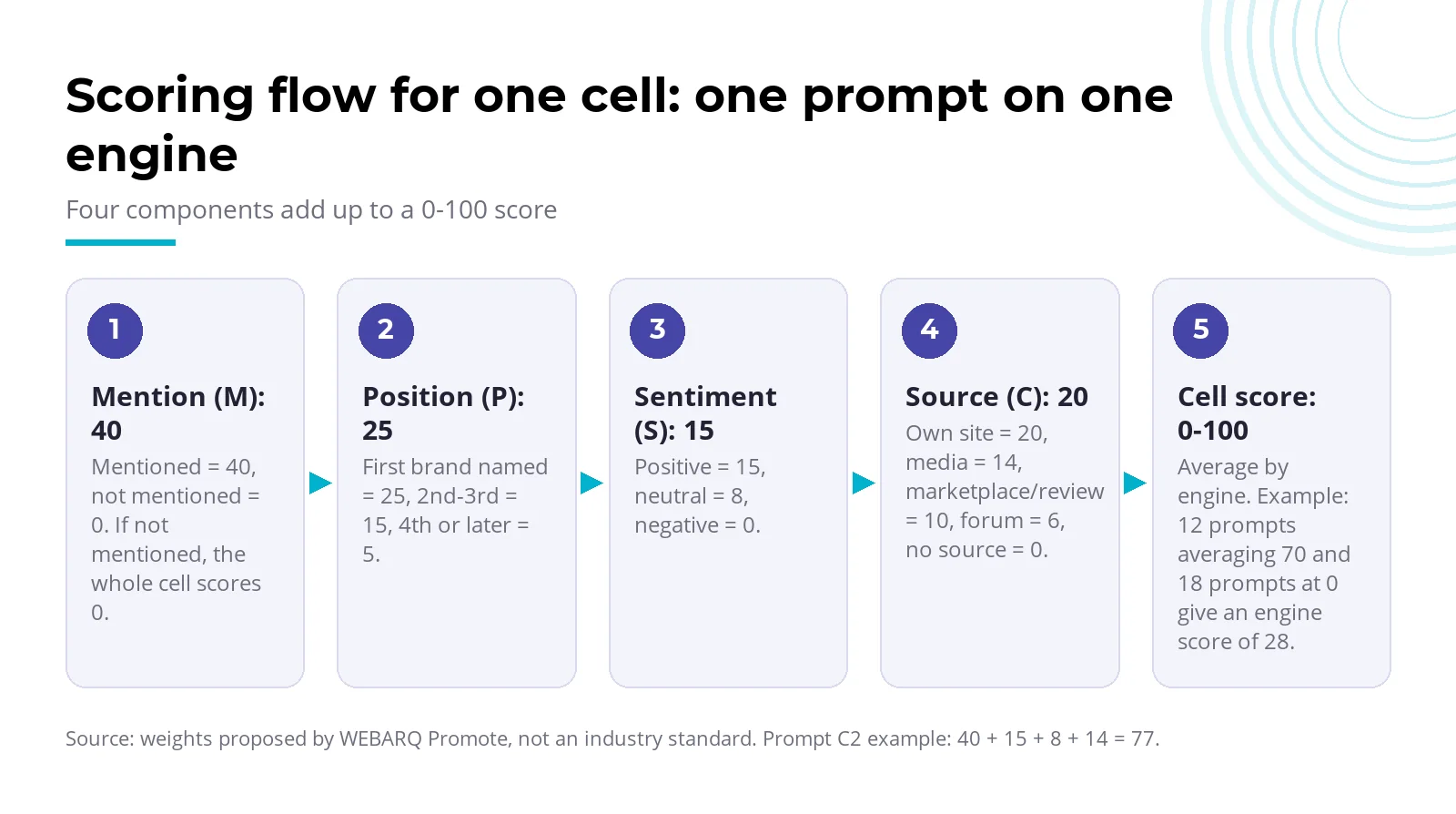
Give every cell (one prompt on one engine) a 0-100 score from four components, then average by engine. The weights below are WEBARQ Promote's proposal, not an industry standard. Mention carries the most weight because without it the other components mean nothing.
If reputation is your priority, say for an issuer under scrutiny, raise the sentiment weight and keep it fixed across rounds.
| Component | Max points | Scoring rule |
|---|---|---|
| Mention (M) | 40 | Mentioned = 40, not mentioned = 0. If not mentioned, the whole cell scores 0 |
| Position (P) | 25 | First brand named = 25, 2nd-3rd = 15, 4th or later = 5 |
| Sentiment (S) | 15 | Positive = 15, neutral = 8, negative = 0. Keep the quoted phrase |
| Source (C) | 20 | Own site = 20, media = 14, marketplace/review = 10, forum = 6, no source = 0 |
For the board, show the score per engine, not just the blended average.
Worked example (made-up brand, not an audit result). On prompt C2, brand X is the second brand named (40 + 15), in a neutral tone (8), with its information cited from a media article (14). Cell score: 77.
On prompt R4, brand X is named fourth (40 + 5) in the context of complaints (0), sourced from a forum (6). Cell score: 51. On prompt C1, brand X isn't named: 0.
Now suppose brand X is mentioned in 12 of 30 prompts on one engine, averaging 70 per cell, and missing from 18. The engine score is (12 × 70 + 18 × 0) / 30 = 840 / 30 = 28. That 28 goes on the board slide, with two notes: where in the funnel the brand drops out, and which sources are cited when it appears.
To absorb variance, run each prompt three times and use the average as the cell value. It triples the work, and the demo below shows why.
How do you run the audit without bias?
Run every prompt in a clean session, with identical wording, three times per engine, and log the date, model and location. Otherwise two people on your team can score the same brand differently.
The engines' own documentation explains why, as of November 2026:
- ChatGPT. Per the OpenAI Help Center, ChatGPT rewrites the question into search queries, may use approximate location from your IP address, and saved memories can shape those queries. Search works without signing in, so test logged out.
- Perplexity. According to the Perplexity Help Center, every answer includes numbered citations. Its "Best" setting picks a model per question, so log which model answered.
- Google AI Overviews and AI Mode. Google Search Central's page on AI features and your website says the two can use different models and techniques, including "query fan-out" (several related searches at once). AI Overviews show only when Google's systems judge they add value.
- Gemini. We haven't verified official documentation on how the Gemini app shows sources, so record what each answer displays.
Use Indonesian prompts for Indonesia, and English ones only if your buyers really ask in English. Test from the locations that matter too: with the [city] slot filled, a property brand can get different answers in Surabaya and Greater Jakarta.
What did the demo run in online accounting software show?
We ran the set for online accounting software for small businesses, a neutral category chosen before the test. One domain in its organic results turned out to belong to a WEBARQ Promote client, so we left it out of the table. The main finding is about the limits of the measuring tool: an AI Overview element was detected in 28 of 28 successful replies, but its text and sources couldn't be read in any of them. So we observed no brand mention in any AI answer.
Method: WEBARQ Promote analysis, November 11, 2026, 25 unique queries + 5 repeats (28 successful replies), DataForSEO SERP (Google, mobile, location Indonesia, language Indonesian) and LLM Mentions data (Google platform). D2 and R1 failed twice with server error 40101 and aren't counted. A2, A4, C8, C10 and D8 weren't run, to keep within a 30-call cap that included repeats. ChatGPT, Gemini and Perplexity weren't tested in this round.
All 28 were placeholders loaded asynchronously, with no text or links. In our 30-query test on October 22, 2026, an AI Overview was detected for 22 of 30 queries and readable for 10. We haven't tested why; the same tool can read differently from day to day.
We could read two nearby signals: domains in Google's organic results, and how often Google's AI answers cite each domain per the LLM Mentions dataset.
| Domain | In organic results (of 23 queries) | LLM Mentions, Google, Indonesia |
|---|---|---|
| akuntansiku.co.id | 8 | not measured |
| bee.id | 8 | 2,522 |
| ukirama.com | 7 | not measured |
| accurate.id | 5 | 9,582 |
| eranyacloud.com | 5 | not measured |
| kledo.com | 5 | 1,269 |
| mekari.com | 5 | not measured |
| jurnal.id | 4 | 4,999 |
| hashmicro.com | 4 | 1,293 |
Organic counts are one appearance per query in the first run, across 23 queries with data. The table lists the domains with the most organic appearances, except scribd.com (a document-sharing site) and that client domain. Some sites are vendor blogs, resellers or consultants. LLM Mentions counts Google AI answers in the provider's dataset that cite the domain on any topic, not just accounting software. That isn't share of voice or traffic, and the table is a one-day snapshot, not a verdict on any product.
On variance: we repeated five queries (C1, C2, D1, D3, R2) minutes after the first call, and only C1 returned an identical domain list. The top result was the same for only 1 of 5. That's volatility in Google's organic results, not AI answer variance, but the message is the same: a single round is weak evidence.
Here's the sheet after the demo; the three AI engine columns are empty because we didn't run them:
| Prompt | Google AI Overview | Google organic (2 calls) | ChatGPT | Gemini | Perplexity |
|---|---|---|---|---|---|
| C1 | Detected, content unreadable | 9 domains, identical, same order | run yourself | run yourself | run yourself |
| D1 | Detected, content unreadable | 8 and 8 domains, 1 shared | run yourself | run yourself | run yourself |
| R2 | Detected, content unreadable | 7 and 8 domains, 4 shared | run yourself | run yourself | run yourself |
How should you read the score, and what comes next?
Treat a low score as a source problem first, not a prompt problem. AI engines build answers from pages they can find and trust, so the fix lives on your pages and on third-party sources that talk about you.
| Pattern on the sheet | Likely cause | Next step |
|---|---|---|
| Rarely mentioned on any engine | No page answers category prompts, or pages aren't indexed | Build direct-answer category, comparison and pricing pages; check indexing |
| Much lower score on one engine | Crawler access blocked for that engine | Check robots.txt and CDN rules, for example OAI-SearchBot for ChatGPT |
| Mentioned, but 4th or later | Rarely in third-party lists and reviews | Build reviews, media coverage and directory profiles |
| Mentioned with negative sentiment or wrong facts | Old sources or unanswered complaints | Document it, correct it at the source, update official pages |
| Mentioned, but always via third parties | Your own site is thin or hard to quote | Add data, definitions and direct answers to official pages |
Two technical notes. Google says no special file, markup or structured data is needed for AI Overviews or AI Mode, a statement that covers Google only. For ChatGPT, OpenAI requires that a site allow OAI-SearchBot and not block its crawler IP addresses at the host or CDN.
On content, the GEO paper found that adding citations, quotations or statistics gave the largest relative gains, up to about 40% on its visibility score. That was a research engine built on gpt-3.5-turbo, not AI Overviews or ChatGPT, so treat it as a direction, not a promise. More in our explainer on generative engine optimization.
For listed companies: don't try to game answers with manufactured content. If an AI repeats wrong information, correct it at the source (press releases, the investor relations page, media that quote old figures), then re-audit the following month.
When is a manual audit not enough?
A manual audit is enough for a baseline and for deciding between fixing the basics and investing in GEO, but not for tracking hundreds of prompts, several countries or weekly trends. Do the math: 30 prompts × 4 engines × 3 rounds = 360 answers to read and score.
Monitoring tools help at that scale, but check coverage first: in our demo, the dataset had no ChatGPT data for Indonesia and the SERP tool returned AI Overviews without content. Ask vendors which platforms and countries they measure, and whether you can see raw answers.
Nor does the audit replace impact measurement. Google counts a site's appearances in AI features inside the Search Console Performance report (Web search type). Pair the audit score with your monthly Search Console report and lead data from your CRM.
No audit guarantees an appearance in ChatGPT or Google. The foundation is still solid SEO: indexed pages, consistent information and sources worth quoting.
Frequently asked questions
What is an AI visibility audit?
An AI visibility audit is a structured test of how often and how AI engines such as Google AI Overviews, ChatGPT, Gemini and Perplexity name your brand when buyers ask about your category. Per prompt and engine, it records the mention, your position among named brands, the sentiment and the type of source cited.
How often should we audit our brand's AI visibility?
We suggest a full 30-prompt audit each quarter, plus a monthly check of about 10 recommendation and reputation prompts. In our test even Google's organic results shifted within minutes, so a trend across rounds means more than one number. Re-run it after a product launch, a rebrand or major news coverage.
Do I need a paid tool for an AI visibility audit?
Not for the first one. The 30-prompt set, clean sessions and a spreadsheet give you a baseline. Monitoring tools help once you need hundreds of prompts, several markets or weekly trends. Before buying, check which platforms and countries the data covers: one dataset we tested had only Google data for Indonesia.
Why do ChatGPT and AI Overview answers keep changing?
Each answer is built fresh. ChatGPT rewrites the question into search queries and can use location and saved memories. Perplexity may pick a different model per question, and Google says AI Overviews and AI Mode can use different models. In our test, even Google's organic results changed for four of five repeated queries.
Does an audit guarantee my brand will appear in ChatGPT?
No. An audit shows where you stand today and which gaps to fix. OpenAI states that placement in ChatGPT search results isn't guaranteed, and Google says meeting every technical requirement doesn't guarantee a page is shown. What you control is source quality, crawler access and consistent brand information.
Your first step this week
Fill the [category], [segment] and [brand] slots in the 30-prompt table, pick 10 consideration and reputation prompts, and run each three times in ChatGPT (logged out), Perplexity, Gemini and Google. That gives you a baseline score per engine and a list of sources to fix.
Want to know how your brand shows up in AI answers? Our AI Search Optimization team can map where you stand.