

Choosing an SEO Agency for Your Company: Pricing Models, Contract KPIs and Red Flags



By Angelica · Updated November 28, 2026
SEO agency pricing in Indonesia has no single market number. On the Indonesian agency pages we read on November 28, 2026, published monthly prices ran from Rp 600,000 to "from Rp 8 million", roughly a 13x spread, for scopes of work that were not the same. What decides a proposal's value is three things: the work you're buying, the KPIs written into the contract, and how any guarantee is defined.
A disclosure up front. WEBARQ Promote sells SEO services too, so the checklist below is built to apply to any vendor, including us.
Key takeaways
- Compare proposals with the formula scope x hours x rate, not package prices. Starting prices on the agency pages we read differed by about 13x.
- Put at least three KPIs in the contract: one technical KPI (for example, Core Web Vitals passing Google's thresholds), non-brand clicks in Search Console, and organic leads that meet your own definition.
- A page-one guarantee is only enforceable if it names keywords, location, device, search engine, time window, starting position and the form of refund. Of the 4 agency pages offering a guarantee, none stated a starting position.
- Send the same 12 RFP questions to every agency, then score the answers with weights you set before opening any proposal.
What are you actually buying when you pay for SEO?
SEO services are work that improves a site and its content so it's easier to find, understand and choose in search results. When you pay, you're buying people's hours across four kinds of work: technical, content, links and measurement. A fair price depends on the mix.
The list of SEO services on Google's Do you need an SEO? page covers reviewing site content and structure, technical advice (redirects, error pages, JavaScript), content development, keyword research, training, and optimization for generative AI.
For each kind of work, ask the proposal to state monthly output and who carries it out. If a separate web vendor or IT team runs your site, technical advice only helps if someone can apply it; otherwise it stays on a slide. Ask early who holds deploy access, and whether promised links are earned or paid for.
SEO pricing models: retainer, project, performance or hourly?
There are four common models: monthly retainer, fixed-price project, performance-based fees and hourly rates. A retainer suits recurring work; a project suits work with clear limits, such as an audit or a migration.
In our reading of 18 agency pages (method further down), 9 showed a price figure, and all 9 used a monthly model. None listed a performance-based or fixed-project price. We also found no citable source for hourly or performance-based SEO prices in Indonesia, so this table carries no figures.
| Model | Fits | What to check before signing | Risk |
|---|---|---|---|
| Monthly retainer | Content, ongoing technical fixes, reporting | Hours and output per month, who does the work, review points | Paying for "presence" without countable output |
| Fixed-price project | Technical audit, site migration, structural cleanup | Deliverables list, definition of done, number of revisions | Finished on paper, never applied to the site |
| Performance-based | Sites with clean conversion data and a clear baseline | Definition of a result, attribution method, fee cap | Incentive to chase easy keywords or irrelevant traffic |
| Hourly | Consulting, coaching an in-house team | Rate per role, timesheets, monthly hour cap | Hard to predict without a cap |
What is a reasonable SEO budget for a company?
A reasonable price covers the scope you need, worked out as scope x hours x rate. Package price lists online hint at a range, but they aren't market prices, because each package contains different work.
Below are seller-published prices from eight pages whose package prices we could record on November 28, 2026: published list prices, not a market survey, with agencies unnamed.
| Page type | Model | Published price per month | Minimum contract |
|---|---|---|---|
| Agency guide, 3 packages | Retainer | Rp 3,000,000 / Rp 4,500,000 / Rp 6,500,000 | 12 months (all packages) |
| Service page, Jakarta | Retainer | Rp 600,000 / Rp 1,500,000 / Rp 1,600,000 ("estimates") | 3 months (starter), 6 months (others) |
| Service page, regional | Retainer | Rp 1,499,000 / Rp 2,499,000 / Rp 3,499,000 | 3 months |
| Service page, Jakarta | Retainer | "from Rp 8 million" | Not stated |
| Service page, SEO+GEO package | Retainer | Rp 5,200,000 (discounted from Rp 9,200,000), first 3 months paid upfront | 12 months |
| Service page | Retainer | Rp 5,000,000 for the Corporate plan (from a Google result snippet) | 12 months |
| Agency guide | Monthly | Rp 1,000,000, or Rp 2,500,000 for 3 months | Not stated |
| Service page | Monthly | Rp 600,000 (site built by them), Rp 950,000 (site built by others) | 12 months |
Starting prices differ by about 13x, and the packages don't sell the same work: keyword counts, who built the site and whether content is included all vary. Google's AI Overview for "harga jasa seo" (SEO service price) also builds its range from seller pages like these, so don't treat it as a benchmark.
Write the scope first (pages to fix, monthly content, who applies technical changes), then ask each agency to convert it into hours per role and a rate. To place that number in an annual plan, see our worked example of a 2027 marketing budget.
If your budget is clearly below what that scope needs, don't force a year-long retainer. Start with a project-based technical audit, fix the biggest findings, then decide on a retainer.
What do Indonesian SEO agency pages disclose?
Most SEO agency pages we read describe methods and promise reports, but few tie reports to leads, and guarantees come almost undefined.
| Item coded | All pages (18) | Service pages only (12) |
|---|---|---|
| Shows a price figure | 9 of 18 | 6 of 12 |
| States a minimum contract | 6 of 18 (12 months on 4, 3 or 6 months on 2) | 5 of 12 |
| Makes its own guarantee | 4 of 18 | 4 of 12 |
| Says it gives no guarantee, or that no one can | 5 of 18 | 3 of 12 |
| Silent on guarantees | 9 of 18 | 5 of 12 |
| Promises a report | 12 of 18 | 10 of 12 |
| Names at least one method (audit, technical, content, links) | All 12 service pages (guides not coded for this) | 12 of 12 |
Of the 12 pages that promise reports, the KPIs named were ranking (6 pages), traffic or clicks (7), and leads or conversions on only 3. Five named no KPI at all, and one page can name more than one KPI.
Method: WEBARQ Promote analysis, November 28, 2026, 12 queries, DataForSEO, 18 pages. We took the top 10 organic results (location Indonesia, language Indonesian, desktop) for 12 Indonesian queries such as "jasa seo", "harga jasa seo" and "jasa seo bergaransi". Marketplaces, directories, social profiles, listicles, local-pack entries and non-agency sites were dropped. Pages owned by companies that sell SEO were kept, up to 3 new domains per query, until 30 pages were selected. Of those 30, 12 couldn't be read or coded (suspended account, 403 or 404 errors, URL couldn't be traced, or not an SEO page).
Every number above is therefore "of 18": 12 service pages and 6 agency guides. Pages we could open may lean toward larger, better-built sites. The sample is small and from one day, so the figures describe the pages we read, not the market.
Which KPIs belong in an SEO contract?
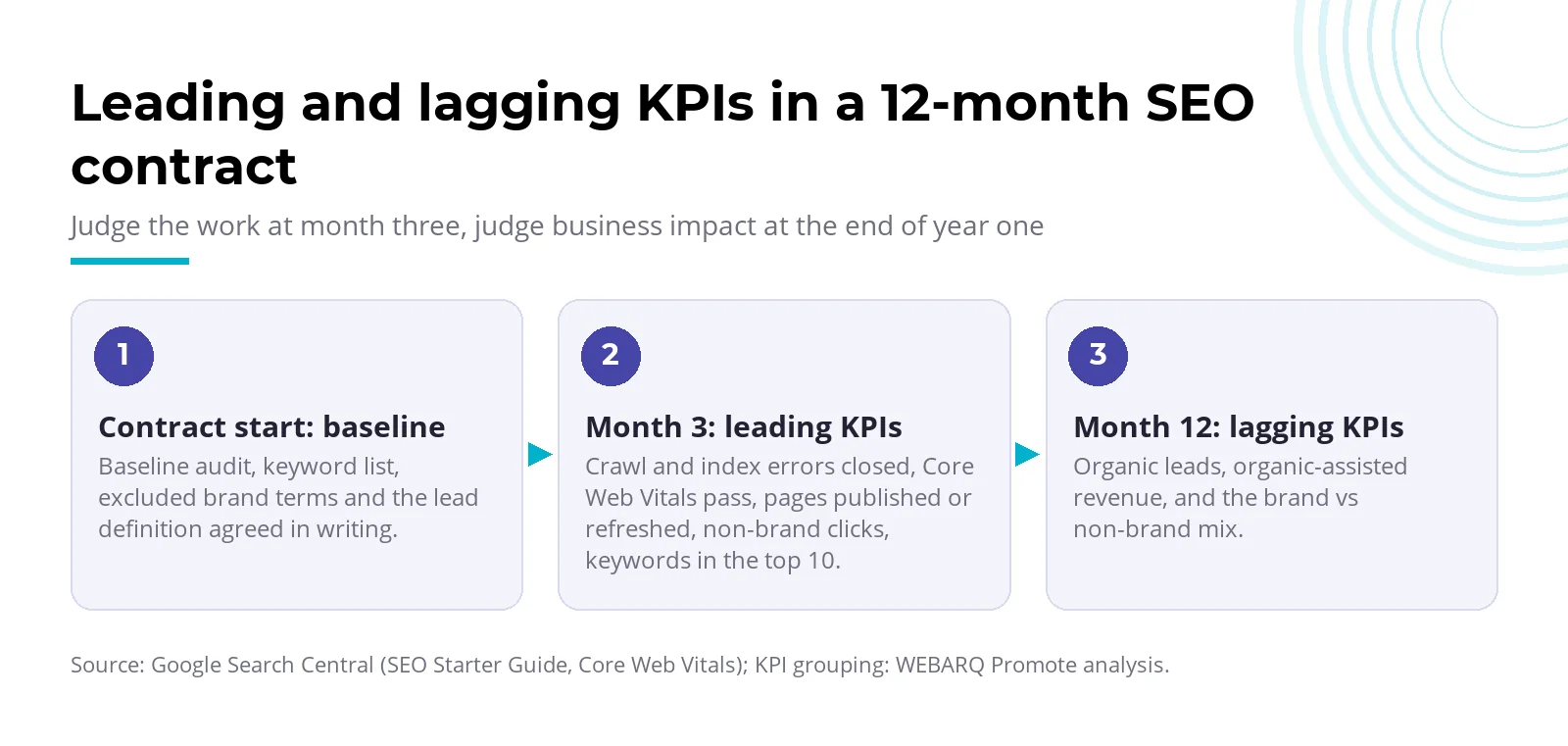
Contract KPIs should come in two layers: leading KPIs that show the work is happening and can be judged within months, and lagging KPIs that show business impact over a year. Write each KPI's definition and data source into the contract.
The reason is in Google's SEO Starter Guide: some changes take effect within hours, others take several months, and judging a single change may take a few weeks. A contract with only lagging KPIs leaves you waiting with no way to measure progress.
| KPI | Type | What it proves | How to specify it in the contract |
|---|---|---|---|
| Crawl and index errors fixed | Leading | Technical work is actually done | Error list from the baseline audit, target number closed per quarter |
| Core Web Vitals pass | Leading | Key pages meet Google's experience thresholds | LCP within 2.5 seconds, INP under 200 ms, CLS under 0.1, measured in the Search Console Core Web Vitals report |
| Pages published or refreshed | Leading | Content output matches the scope | Number per month, with URLs listed in the report |
| Non-brand impressions and clicks | Leading | The site is visible beyond searches for your name | Search Console data, with the excluded brand terms agreed at the start |
| Share of target keywords in the top 10 | Leading | Progress on the keywords you chose | Written keyword list, location, device, measurement tool and dates |
| Organic leads or qualified sessions | Lagging | Search brings in potential customers | Lead definition you approve (for example, a fully completed form), data source in analytics or CRM |
| Organic-assisted revenue | Lagging | Contribution to sales | Agreed attribution model, CRM data source |
| Brand vs non-brand mix | Lagging | Growth isn't only from people who already know the brand | Non-brand clicks as a share of total, per quarter |
| Mentions in AI answers | Monitoring, not guaranteed | How the brand shows up in AI answers | The same 30-prompt audit each quarter, logged as monitoring, not a target |
The Core Web Vitals thresholds in the table come from Google's Core Web Vitals documentation. The brand split, lead definition and error list are agreements with the agency; Search Console doesn't define them. A monthly report format that works for leading KPIs is in our guide to monthly Google Search Console reports, and how to run a 30-prompt audit is in our AI visibility audit with a scoring sheet.
KPIs that should never be the only measure
Rankings, traffic and impressions are useful signals but risky alone. Under Search Console's metric definitions, an impression counts whenever a link to your site is seen on Google, including links that only come into view after scrolling. Position is a relative average, with 1 as the top.
So "average position 3" in a report is an average across many queries, countries and devices, not "ranked 3 for this keyword in Jakarta on mobile" (our reading of Google's definitions). Traffic can also rise from informational articles that never produce a lead, so pair it with an organic-lead KPI.
Can a "page-one guarantee" be held to account?
A page-one guarantee can only be held to account if the contract defines what's guaranteed, how and when it's measured, and what happens if it fails. Without that, it's marketing copy, not a commitment. Google also says no one can guarantee a #1 ranking.
On its Do you need an SEO? page, Google tells site owners to be wary of SEOs that guarantee rankings or claim a "special relationship" with Google. If an SEO guarantees its changes will put your site first in results, Google says, find another SEO.
In our reading, 4 of 18 agency pages offered their own guarantee. None named the keywords (two gave only a count, such as "15 keywords"), and none mentioned device, location or starting position. Only 1 of the 4 mentioned a refund; 1 offered free extra service instead.
Before you sign any guarantee, make sure these seven things are written down:
| Element | Question the contract must answer |
|---|---|
| Keywords | A list naming each keyword, not "15 keywords" |
| Search engine | Google only, or others too? |
| Location | All of Indonesia, Jakarta or a specific city? |
| Device | Desktop, mobile or both? |
| Time window | When is it measured, and how long must it hold? |
| Starting position | Each keyword's position when the contract starts, with date and measurement tool |
| Remedy | Full refund, partial refund or extra service, and how the process works |
We apply the same demand to ourselves. The WEBARQ Promote SEO services page offers "a guarantee to reach the first page of Google, or your money back". Our case studies also publish figures such as Indonet: "404%: Growth in organic traffic" and "78%: Percentage of reaching Google's first page in 6 months". That case-study page doesn't list a baseline or the keyword set. Whoever the vendor is, us included, get the guarantee's definitions and expected results in writing for your site.
12 RFP questions for prospective SEO agencies
Send the same 12 questions to every agency so answers are comparable. Most are adapted from Google's suggested interview questions.
Process
- What does the initial audit cover, and what estimate of improvement and task list will we get from it?
- How does your work follow Google Search Essentials, and which practices will you not use?
- What results do you expect, over what timeframe, and how do you measure success?
People 4. Who will work on our account, how many hours per month per role, and who takes over if they leave? 5. What experience do you have in our industry, in our target city or country, and with multilingual sites? 6. Can you show examples of past work, including the starting point and how it was measured?
Data and access 7. What access do you need? Google suggests read-only Search Console access at the audit stage. 8. Who owns the analytics account, the Search Console property and the content produced, including after the contract ends?
Reporting 9. Which leading and lagging KPIs will you report, from which data source, and how often? 10. Will every change to the site be logged along with the reason for it?
Contract 11. How does your guarantee clause define keywords, location, device, time window, starting position and remedy? 12. If you recommend AEO or GEO work, how does that advice match Google's guidance on generative AI features?
Question 12 matters because, per Google's page on AI features, AI Overviews and AI Mode need no special optimization beyond good SEO. If the agency will access data that includes customers' personal data, also ask your legal team how that fits with Law No. 27 of 2022 on Personal Data Protection (UU PDP).
Red flags before you sign an SEO contract
Each of these seven signs is a reason to stop and ask more. Most come from Google's own warnings.
- A guaranteed #1 ranking. Google says no one can guarantee it.
- Secret or unexplained methods. According to Google, the site owner remains responsible for what the hired party does.
- No audit or baseline before targets are set.
- Paid link packages. Google's spam policies count buying or selling links for ranking as link spam. We'll cover backlink services in a separate article.
- Reports that contain only impressions and rankings, with no non-brand clicks or leads.
- Full access requested, but no data access for you, or analytics accounts set up in the agency's name.
- Automatic renewal with no review point and no exit clause.
Google also tells you to be skeptical of unsolicited SEO emails. Broader signs of a problem vendor are in our article on characteristics of digital agencies to be cautious about.
Checklist before choosing an agency: score the proposals
Set the weights before you open any proposal, then score each criterion from 1 to 5. The weights below are our suggestion for mid-size and large companies; adjust them to your priorities.
| Criterion | Weight | Score 5 if | Score 1 if |
|---|---|---|---|
| Clarity of scope and hours | 25% | Hours per role and monthly output written down | Only a package name and keyword count |
| KPIs and reporting | 25% | Leading and lagging KPIs with definitions and data sources | Rankings and traffic only |
| Method and fit with Google's guidance | 20% | Explains each kind of work, no paid links | "Secret" methods or backlink packages |
| Team and relevant experience | 15% | Named roles, examples of work with a baseline | Unclear who does the work |
| Contract and data terms | 15% | Defined guarantee, data owned by you, exit clause | Auto-renewal, data in the agency's accounts |
Two decision rules complete the score. If two proposals are within 10% of each other, pick the clearer scope, not the lower price. If none scores at least 3 on KPIs, ask for revisions before discussing price.
Frequently asked questions
How long does it take for SEO work to show results?
There's no general number of months, and Google doesn't give one: a change can take effect within hours or only after several months. In contract terms, judge leading KPIs such as technical fixes and non-brand clicks at month three, and organic leads at the end of year one.
Is a monthly retainer or a fixed project better for a company?
Choose a project when the work has clear limits and a definition of done, such as a technical audit or a site migration. Choose a retainer for monthly recurring work like content and reporting. If unsure, start with a project-based audit; its findings show how large a retainer you need.
Is an SEO agency with a page-one guarantee a safe choice?
Only if the guarantee is enforceable. The contract should name the keyword list, location, device, search engine, time window, each keyword's starting position and the refund. Treat a promised #1 ranking as a red flag, because Google says no one can guarantee that position.
Should we sign a 12-month SEO contract?
No length is right for every company. On the agency pages we read, a 12-month minimum was stated most often (4 of 18 pages). If you agree to 12 months, ask for a month-three review and an exit clause if leading KPIs are missed, and have your legal team check the wording.
Do SEO and AI search optimization need separate vendors?
Not necessarily. Google says appearing in AI Overviews and AI Mode has no extra requirements; good SEO practice is the foundation. Keep the measurement separate: track brand mentions in AI answers with a regular prompt audit, and turn down any vendor that guarantees AI visibility.
This article is general information, not legal advice. For contract wording and personal-data handling, consult your legal team.
If you're comparing proposals and want one built on the same framework, the WEBARQ Promote SEO services team can start with a technical audit of your site and answer the 12 questions above in writing.