

Google Explains How AI Mode and AI Overviews Pick Sources: What Marketing Teams Should Check



By Della · Updated November 27, 2026
Google AI Mode and AI Overviews choose sources from the same Search index and ranking systems as regular results, then link the pages that support what the answer says. That's the core of Google Search Central's documentation on attribution and factuality in generative AI features, updated November 24, 2026. The requirements are ordinary: the page is indexed, it's eligible for a snippet, and the site isn't excluded in Search Console.
This matters locally. AI Mode has been available in Bahasa Indonesia since September 9, 2025, and now how it works is written down.
Key takeaways
- Per Google's documentation (updated November 24, 2026), AI answers are built in four steps: Search index results, related searches, grounding and corroboration, then link display.
- Only pages that are indexed and eligible for a snippet can become supporting links. No special schema or AI-specific files are needed.
- The Search generative AI setting in Search Console defaults to Include, but child properties can inherit or override the parent's value.
- The Generative AI performance report documents impressions only. Read clicks from the regular Performance report.
What does Google say about how AI Mode and AI Overviews pick sources?
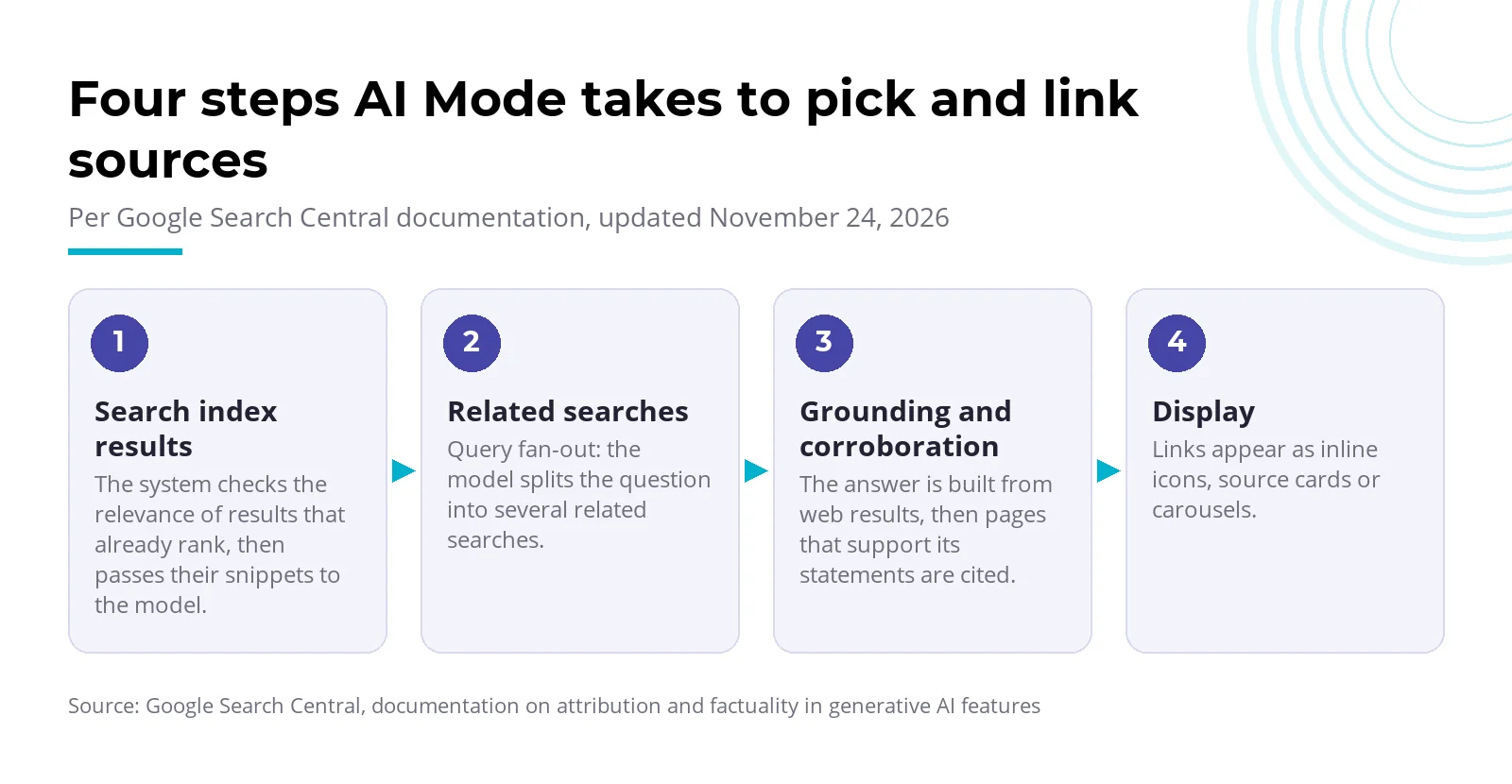
Both features use a customized Gemini model connected to Search's core ranking, retrieval and quality systems, so answers rest on current pages in the index rather than only on what the model learned in training. The process has four steps.
- Search index results. For AI Overviews, the system checks the relevance of results that already rank, then passes their snippets to the model.
- Related searches. The model can run extra searches for other parts of the question.
- Grounding and corroboration. The answer is built from those web results, then the pages that support its statements are cited and linked.
- Display. Links appear as inline icons, source cards or carousels with site name, favicon and title, weighing relevance, quality signals, layout and source diversity.
Query fan-out is the technique where the model splits one question into several related searches, then combines what it finds. Before an answer shows, two checks run: safety and policy guardrails, and corroboration of claims against web results, data feeds and the Knowledge Graph.
What does this mean for your pages?
A page that isn't indexed, isn't eligible for a snippet, or sits in a property set to Exclude can't become a supporting link, however good it is. Google's other statements each turn into a concrete check. The table below is WEBARQ Promote's reading of it.
Method: on November 27, 2026 we read the page line by line, along with three help pages (AI features and your website, Search generative AI control, Generative AI performance report). The "What it means" and "How to check" columns are our inferences, not Google's words.
| What Google says | What it means (our reading) | How to check | Owner |
|---|---|---|---|
| Supporting links only go to indexed pages eligible for a snippet | There is no separate AI index | Pages report and URL Inspection | SEO, dev |
| The site must be included in Search generative AI features | If the value is Exclude, nothing else matters | Settings > Search generative AI on every property | SEO |
| Snippets from already-ranking pages go to the model | The opening sentence of each section shapes what the model reads | Look at the live snippet for target queries | Content |
| The model runs related searches | Pages ranking for sub-questions get a chance too | List 5–8 sub-questions per topic and make sure each is answered | Content |
| Pages are cited because they support a statement | Unsourced text is hard to corroborate | Check that key claims have data or a primary source | Content |
| Key information is available as text, with trust cues | Content in images or tabs that don't render can't be read | Rendered HTML; author and About pages | Dev, content |
| Don't change dates unless the content changed substantially | Bumping dates to look fresh goes against the guidance | Compare the published date with CMS edit history | Content, dev |
| Limit text with nosnippet, data-nosnippet, max-snippet | nosnippet likely removes a page as a supporting link | Crawl templates for all three directives | Dev |
Do the first two rows first. They're yes-or-no, while the rest are content quality work that takes time.
Why might AI answers not appear for finance and health topics?
Google says its system is built to hold back an AI answer when the answer could be unsafe, could violate Search policies, or when reliable sources don't agree. Its examples are sensitive YMYL (Your Money or Your Life) topics and breaking news with thin coverage. That's a per-query bar, not a sector ban.
Our small check points the same way. On November 27, 2026 we ran 7 Indonesian-language queries through DataForSEO (location Indonesia, desktop). An AI Overview appeared for 6 of 7 queries, including "bank digital terbaik" (best digital bank), "kredit usaha rakyat syarat" (KUR loan requirements) and "obat maag yang aman" (safe gastritis medicine).
The seventh query returned a partly broken results page. The sample is too small and not random enough to say how often answers are withheld.
For banks, insurers and clinics, the work is on your own pages: named authors and reviewers, honest review dates, and references to regulations or official data.
Which Search Console settings should you check this week?
Two: the Search generative AI control on every property, and the Generative AI performance report (checked in Search Console Help, November 27, 2026).
The first lives under Settings > Search generative AI with three values: Include my site's links and content (default), Exclude, and Inherit from parent. A site set to Exclude isn't linked, and its content isn't used in AI Overviews, AI Mode or AI features in Discover. A property follows its closest parent with its own value, so in our reading a blog on a subdomain can differ from the main site. The setting isn't a ranking signal elsewhere in Search, and it's not the same as Google-Extended, which governs AI training.
The report shows impressions for AI Overviews and AI Mode, with Pages, Countries, Dates and Devices as dimensions and a 1,000-row table limit. Its help page lists no clicks or queries, so treat it as a visibility signal, not a traffic report. Search Engine Journal, quoting a Google note, reported the report reached all sites by August 31, 2026. Clicks from both features still land in the Performance report under Web, as covered in our guide to monthly Google Search Console reports.
For urgent errors, the Removals tool can take a page down for about 6 months. It applies to all of Google Search, not just AI features.
What doesn't Google say?
There's no secret formula. The page gives no ranking weights, no number of links per answer, no list of withheld sectors and no promise that any page will be cited, and it doesn't mention Indonesia.
For Google Ads teams: per Google Ads Help, opened November 27, 2026, Indonesia is listed as "AI Overviews only" for ads within AI answers, in English only. Ads within AI Mode aren't listed for Indonesia. Ads above or below AI Overviews run in more than 200 countries and territories.
We covered the traffic impact of AI Overviews in our article on AI Overviews and business traffic, and the December core update in our piece on traffic drops after a Google core update.
What can a marketing team get done in one week?
- Monday, property owner: check the Search generative AI value on every property (domain, www, subdomain, URL prefix).
- Tuesday, SEO: export the Pages table from the Generative AI performance report and compare it with clicks in the Performance report.
- Wednesday, dev: crawl templates for nosnippet and max-snippet, then turn off automatic date updates.
- Thursday, content and compliance: run 15–30 target queries, including YMYL ones, using the sheet from our AI visibility audit with 30 prompts.
- Friday, content: add sources to claims on your five pages with the most impressions, then request reindexing.
If Monday turns up an Exclude nobody intended, stop and fix that first.
Frequently asked questions
Does AI Mode use Google's regular ranking?
Largely, yes. Google says AI Overviews and AI Mode use a Gemini model connected to Search's core ranking, retrieval and quality systems. AI Mode also runs related searches, so pages that rank for sub-questions can be cited too. Google notes the two features may use different models and techniques, so results can differ between them.
Do I have to sign up to appear in AI Overviews and AI Mode?
No. The Search generative AI setting in Search Console is set to Include by default, and Google says there are no extra technical requirements beyond being indexed and eligible for a snippet. Just make sure no property is set to Exclude, including through inheritance from a parent property. Meeting the requirements still doesn't guarantee a citation.
How do I track traffic from AI Mode and AI Overviews?
Clicks from both features count in the Search Console Performance report under the Web search type, mixed with other organic clicks. The Generative AI performance report adds impressions by page, country, date and device, without clicks or queries. Combine the two with your analytics to see the effect on leads.
Does nosnippet remove a page from AI answers?
Most likely, yes. Google requires a page to be eligible for a snippet to appear as a supporting link; the conclusion that nosnippet takes it out is our inference. If you only want to limit the text shown, data-nosnippet on specific sections or max-snippet on length is the better tool.
Does updating an article's date help it get cited by AI?
There's no basis for that. Google's documentation asks site owners not to change a page's date unless the content has changed substantially. Update the facts first, such as figures, prices or rules that have changed, then the date, and switch off automatic date updates in your CMS.
Want to know how your brand shows up in AI answers? Our AI Search Optimization team can map where you stand, from Search Console settings to the pages being cited. Visibility in AI answers can't be guaranteed, but the things you can check are worth checking now.